View from the Foothills of France

Some personal views on living, working,
bringing up family and making the dream happen in the most beautiful region of France. View from the Foothills of France also includes some personal and professional thoughts and tips on finding and buying the perfect property in the Ariège and Haute Garonne regions.

Archives

Categories

Is moving to France really for you?

img_0401

Have you considered the practicalities?

If this is going to be a permanent move, it means that there are many emotions involved so it is vital to put some of these aside. It is great to have a dream but it needs to be based on reality for your move to work long-term. For example, if you still need to make a living post your move to France, bear in mind that this is harder in a foreign country so don’t just move and then hope to find employment. Work out the career and income first and then start looking for the house. If it is a retirement home, make sure you have worked out how your pension will transfer and get advice on tax and healthcare implications. This is easier said than done right now as nobody knows what is going to happen post Brexit but agreements will be worked out and you will need to be aware of them and make sure they are going to work for you. If it is a holiday home, are you going to be renting it out and, if so, when do you want to use it yourself? If in peak holiday times, this could be a problem for making any rental income. In addition, you will be having to manage another property from abroad so make sure that you have the time to do this and consider locations that will make this easier.

Why France?

Presumably you have been on holiday to France and loved it but living in another country year-round is different to being on holiday so make sure you visit out of season and talk about the pros and cons with other people who have made the move. Quality of life in France is often said to be the best in the world but it has to be a quality of life that suits you; if you are used to having mod cons and lots of conveniences on your doorstep, moving to rural France may not offer the quality of life you are after. France is a hugely varied country so you need to decide what lifestyle you are looking for and which region can provide this on a day-to-day basis.

Which house?

Once you have decided that France is definitely for you and have narrowed down to a specific region, you can start to think about the style of home you are looking for and the type of property that will suit you best. Do you want a large farmhouse with lots of land in the middle of nowhere, a smart Maison de Maître in a village or town, a lock-up-and-leave village house or an apartment in a ski or spa town with all facilities? It is safe to say that you can find pretty much any kind of property here in France but a perfect house in the wrong location is the wrong house even if it ticks every other box. So before you begin your property search, make sure you know the sort of lifestyle you want and also, how you are going to achieve it. Then do your research and find an area you love, which also suits your lifestyle and that you can afford.

Finally start thinking about the kind of house that would work for you. This is the part I can help you with so, once you have reached this stage, get in touch and I will make sure this stage of the process is easy, un-stressful and hopefully enjoyable to boot.
 

Ten things to know about school in France

p1000910-aula-bis-400x300


  1. There are four tiers of school in France, Maternelle (nursery 4-6 years), Primaire (primary 6-11 years), College (secondary 11-15 years), Lycée (sixth form 15-18 years)
  2. The majority of children in France go to their local and usually closest primary and secondary school which are state funded and controlled
  3. Private education only really exists in terms of Catholic schools which are deemed ‘private’ but teachers are employed and paid by the state and fees are around €100 per term. There is also a very small network of high fee-paying private schools and international schools
  4. Formal schooling doesn’t start until six years of age in France but then the school day is long; 8am – 5pm although there is only morning school on Wednesdays
  5. There is no headmaster or headmistress as such in French schools; teachers are answerable directly to the regional education authority and a teacher is designated ‘director’ for administrative tasks each year. Secondary schools have a non-teaching, full-time director in charge
  6. Children do not wear school uniform in French schools
  7. French schools are strictly secular (unless designated Catholic and hence private) and no celebration of religious festivals is permitted
  8. French schools tend to put a great deal of emphasis on the core subjects of French and Maths with less time given to imaginative/creative subjects. There also tends to be a fair amount of learning by heart, especially in the case of poems and dictation
  9. Children often have to repeat a year during their school lives to ensure they have reach expected levels but there is no shame attached to this.
  10. Many children (often more than 50%) go home for lunch with their parents. Others eat in the school restaurant which is paid for by the family and is made up of a three course, balanced meal. Packed lunches do not really exist unless taken for a school outing


Latest French property market news

img_0143

So far this Autumn, there continues to be signs of recovery in the housing market in France, with strong sales and prices moving upwards in many areas.

The impetus behind this recovery is probably down to a number of combining factors which include historically low interest rates and the weakness of the Euro against many other world currencies. In addition, while property prices are beginning to rise, property in France still offers incredibly good value for money along with, of course, the much envied quality of life inherent in the French lifestyle.

It is worth noting, however, that the overall upward movement in prices does not allow for a wide variety of regional market trends with prices in some departments and regions actually falling in the period, particularly in those areas where there have been the greatest price rises in the last few years such as Paris and the Languedoc.

The last two years have seen a large increase in the number of buyers from the UK. According to a joint survey by the Notaires of France, BNP Paribas and Rightmove, UK buyers accounted for 44% of all transactions in 2014 and 34% in 2015. The first half of 2016 has also seen a very buoyant property market and a strong representation of British buyers but the jury is still out on the market effects of Brexit and the accompanying uncertainty over the coming months and years.

In this region, it is the Ariège which has seen the greatest increase in prices, up 7.5% this year. The Haute Garonne has seen rises of 1.8% so far this year while the Gers has fallen 2.1%.

An unusually faithful conversion

P1090832

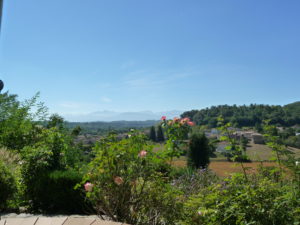
In this job, I am lucky enough to visit a huge number of very interesting and unusual properties. These can range from crumbling mountain barns to enormous Chateaux and pretty much everything in-between but this week was the first time that I have viewed a converted chapel which probably shows how unusual this property is. Even before the conversion, it’s history makes for an interesting building; it was apparently built by a local priest in 1858, using his own money, in memory of Queen and Sainte Radegonde who founded the Monastery of Sainte-Croix in Poitiers and spent time in this region selecting the famous marble which is found in this area. The chapel is on the edge of a historic village with Roman and Romanesque remains and, as with most religious buildings here in South West France, the priest clearly picked his spot carefully; it is set on a stunning promontory overlooking the village and valley below with beautiful views of the Pyrenees.

P1090857

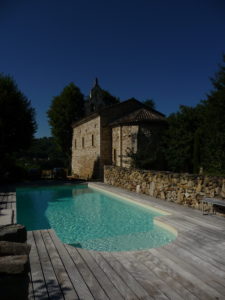
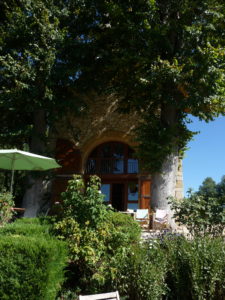
Apparently the chapel was primarily designed and used as a sanctuary and for religious celebrations. The last ceremony was in 1939 and, after that, it gradually fell into disrepair until rescued by the current owners. Over the last ten years, they have lovingly restored its exterior stone façade and landscaped the surrounding walled gardens, adding a pool that cleverly mirrors the shape of the building. Inside, sensitive to its important history and respecting the layout, the owners have inserted a modern home within the walls without impacting on the structure or overall feel of space and calm. Somehow they have managed to fit in four bedrooms and yet retain the height and create a very bright and comfortable interior.

I won’t go on or I will start to sound like an estate agent but I think this property will make someone a very special home or holiday house and it also strikes me as the perfect party house or retreat. In fact, with the current trend for Airbnb unusual style rentals, it would also make a fantastic investment especially as it is just five minutes from the mainline train station to Toulouse and to the coast and 40 minutes by car from central Toulouse and the international airport and an hour from the ski resorts.

P1090838

This is the kind of property I probably won’t see the likes of again and it could well be sold by the time I post this article but, if you would like more information, please do get in touch, it’s well worth adding to your viewing short-list: nadia@foothillsoffrance.com