View from the Foothills of France

Some personal views on living, working,
bringing up family and making the dream happen in the most beautiful region of France. View from the Foothills of France also includes some personal and professional thoughts and tips on finding and buying the perfect property in the Ariège and Haute Garonne regions.

Archives

Categories

France goes pesticide free

Since the start of the year, local authorities in France have been banned from using chemicals to clear weeds in public spaces, on roads and on paths. From 2019 this law will also apply to private householders. This pesticide ban is part of wider legal change in environmental law which will includes a ban on throwaway plastic bags for fresh produce (including at markets) and, from 2020, a ban on plastic cups, plates and utensils.

Pesticides are now proven to be dangerous to health (as well as destroying fragile ecosystems and destroying natural balance) and, in the last few years many French communes have already begun to rethink how they can maintain public spaces without using chemicals. Many have already turned to gas burners to get rid of weeds and traditional methods such as salt and vinegar on paths.

The city of Lyon has been pesticide free since 2008 in all its 300 parks and gardens, turning instead to the help of thousands of ladybirds brought in to eat aphids and other bugs and by using mulch to stop weeds on the soil, beer traps to cut down on slugs and natural compost from its garden waste. Before 2004 it spent €30,000 a year on chemicals and pesticides on transporting 3,500 tonnes of leaves and grass clippings by lorry to a company that turned it into compost. Now the city has bought its own garden shredders and created its own composting area, increased its green spaces by 10% and the whole system pays for itself.

France does not shout about its green credentials but it is way ahead of many countries in this area and it is these continual little improvements (which often go unnoticed) that gradually but substantially improve the much talked about quality of life in France and for all of us who live here or who are planning to live here one day.

The advantages of a stable housing market

According to the OECD, property prices in many advanced economies are at dangerous levels raising the risk of massive price falls if markets overheat. This comes amid predictions of higher interest rates, higher inflation and general political uncertainty worldwide.

The OECD’s report said countries such as Canada, New Zealand and Sweden have all seen rapid increases in house prices over the past few years that were “not consistent with a stable real estate market”. Meanwhile, the EU’s financial risk watchdog recently warned that eight countries in the EU, including the UK, had property markets that risked overheating in the environment of low interest rates.

France, however, has always enjoyed one of the most stable housing markets in the world, with steadily increasing prices rather than dangerous peaks and troughs and, hence, it is still considered to be one of the safest and most secure markets for property investment.

A recent BNP-Paribas report noted that, although ‘France has suffered like most Western countries in the midst of the recent financial and fiscal crises, the country’s real estate sector has remained steady. Property prices in France have increased steadily over the 20th century, and while there have been some notable blips during that time, those investors who are prepared to plan for the long-term should expect more of the same. Despite the drying up of credit, sovereign debt and austerity measures, the French property market has proved that it is robust and sufficiently stable to withstand temporary periods of decline. The French property market is one of the most well-regulated in the world, so British investors should not be too concerned about the country’s long-term outlook’.

In addition, thanks to the dominance of fixed rate mortgages, France’s housing market is likely to be much less prone to sharp upturns and downturns than housing markets in other countries, where variable-rate housing loans are a major source of instability.  Variable-rate loans only make up 6% of new loans in France, and around 15.6% of outstanding housing loans, according to the Autorité de contrôle prudentiel et de résolution (ACPR).

France’s lifestyle appeal remains as strong as ever, there are no restrictions on foreign ownership in France, property prices still offer incredibly good value and the country is still one of the most desirable countries in which to own property. So if your dream is to have a house in France, it is still a very sensible dream that makes sense both in terms of quality of life and as a sound financial investment.


Christmas in the foothills of France

Organic Christmas Tree Farm in the Ariège

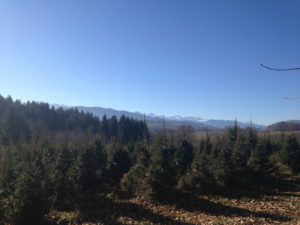
What an extraordinary year 2016 has been but probably the less said about all that the better. Right now, here in the foothills, we are enjoying the typical weather of this time of year; sunshine and blue skies, with frosty mornings, warm days and chilly evenings best spent in front of the fire. This is such a perfect location for Christmas because, while down in the valleys, we can make the most of the mild days, we also get the pleasure of looking at the snowy Pyrénées on the horizon with the promise of skiing, snow-shoeing and sledging just a short drive away whenever we feel like it.

The French have got Christmas just right in this part of the world; they manage to take the best bits, discard the stress and overspending and focus on eating, drinking and enjoying time en famille.

The last few months, it has been very evident that there has been a change of focus in terms of French property buyers; the majority of my property search enquiries lately have been for mountain barns, eco-properties and hidden valley houses with lots of land, surrounded by natural resources. It makes me think that many of us are looking for somewhere unspoiled and beautiful that feeds the soul, where we can feel safe and self-reliant whatever the next few years bring. I am certainly not making any predictions for 2017 save to say that, if you are looking for a better quality of life in general, then France still offers that in spades whatever the time of year and whatever is going on elsewhere in the world.

Wishing you a very happy Christmas à la français.


The Foreigner’s guide to French politics

Known as ‘The Fifth Republic’, the French political system is a mixed presidential/parliamentary system with a President who is head of state, sharing power with a Prime Minister who is the head of government. The French as a nation are very fond of politics so, if you plan to spend any time in France, it is sensible to have at least a vague grip on the political landscape of the country.

Parliament is made up of the National Assembly (the lower house) which sits in the Palais Bourbon with 577 députés elected from single member constituency in a two-rounds system. The Senate (the upper house) is housed inside the Luxembourg Palace and has more than 300 senators elected by around 150,000 officials from around the country and is politically conservative.  Under the constitution, the two houses have similar powers.

There is a multi-party system with a great many different political parties which can be roughly categorized as ‘Left’ or ‘Right’. Here are the main ones:

The left

The Parti Socialiste or Socialist Party (PS) is the main party on the Left and was formed around 40 years ago from an alliance of parties of the non-Communist left with a welfare state and participative democracy as cornerstone policies. Since June 2012, the Parti Socialiste has been the party in power.

The right

The ‘conservative’ Union pour un Mouvement Populaire (Popular Union Movement) or UMP is one of the largest parties. It was created by Jacques Chirac after he was re-elected as President in 2002 and it united the Right in a single party. It covers a range of opinions ranging from traditional conservatives, social liberals to more-right leaning, neo-conservatives. It describes itself as a ‘Gaullist’ party, upholding social conservatism which is patriarchal and nationalistic.

The UMP are allied in parliament with the centre right party, Nouveau Centre (New Centre). In September 2012, a new centrist federation Union des Démocrates et Indépendants (UDI) was formed.

Finally, there is the Parti Radical, the oldest political party in France, and a progressive and humanist party once of the Left, is now a corporate member of the UMP.

Although these parties represent the French political Right, they are probably closer politically to the Democrats and Labour, than to the Republicans and Conservatives, in the US and UK.

The middle 

Former presidential candidate François Bayrou set up the Mouvement Démocratique (Democratic Movement) or MoDem as a middle way party.

The Alliance Centriste is another centre-right party.

This year we also have a self-styled ‘centriste’ politician, Emmanuel Macron who has recently declared himself as a presidential candidate having resigned from his position as France’s Economy Minister. In terms of policy, he claims to represent a ‘Third Way’, a neoliberal agenda offering structural reform and promising to listen to the people; the broom that promises to sweep clean and start politics anew.

The far right

The Mouvement Pour la France (Movement for France), a small sovereignist party, rather similar to the UK’s UKIP party, is positioned between the Right and the Far Right.

The Front National (National Front) or NF was founded by Jean Marie Le Pen in 1972 and is currently led by his daughter Marine Le Pen. Similar to the British BNP, the Front National is an extreme Right wing party which campaigns on national preference, law and order and anti-immigration issues.

Both parties are calling for France to leave the European Union.

The next French general election is next Spring 2017 and looks like shaping up to be a battle between the right (Filllon, whose polices are being hailed as ‘neo-Thatcherite) and the far right (Marine Le Pen who is positioning her party as the populist choice).

After the UK and US unexpected election results of 2016, I’m certainly not making any predictions!


Thanks to Expatica, Wikipedia and France24 for some of the above