View from the Foothills of France Some personal views on living, working,
bringing up family and making the dream happen in the most beautiful region of France. View from the Foothills of France also includes some personal and professional thoughts and tips on finding and buying the perfect property in the Ariège and Haute Garonne regions.
|
By nadia, on 19th June 2013 
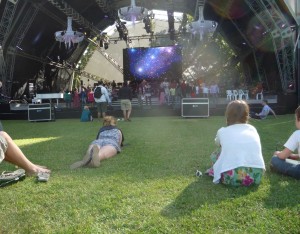
Summer here in France begins with the sound of music. The 21st June marks the date not only of the first day of summer but, more importantly, of the public celebration of music and arts that is the Fête de la Musique. Launched in 1982 by the then Minister for Culture in order to promote music for everyone, it has become a much loved and celebrated festival all over France and has also spread to hundreds of other countries around the world.
On the 21st June from midday to midnight, just about every town in France will have some sort of event or concert taking place and all genres of music on the streets, in the squares, in public buildings, parks, stations and castles along with, of course, plenty of good food, wine and merrymaking. The department of the Ministry of Culture in charge of promoting the Fête de la Musique requires that all concerts must be free to the public, that all performers donate their time for free and that it be open to any musician, amateur or professional, who want to perform in it (hence the quality of the music on offer can vary hugely!) The aim of the Fête is to attract as large an audience as possible and to popularise every kind of music from classical to rock, jazz to fusion, latino to choral, for everyone of all ages and from all backgrounds.
Furthermore, the Fête de la Musique is a way to encourage the major music institutions (orchestras, operas, choirs, music schools) to perform outside their usual location and to develop exchanges between city centres and their outlying areas, to offer concerts in hospitals or in prisons, to promote encounters and exchanges between young musicians and well-known talents and to encourage a love of music of every and any kind.
Celebrated in over 110 countries around the world, it is now the world’s largest music event and if you are in France on 21st June, it is guaranteed to be happening where you are. Bonne fête.
Like this:Like Loading...
By nadia, on 30th May 2013 
House prices in France have been slowly falling for the last two years but 2013 has seen the market stabilise and prices and property transactions now appear to be on the increase in this region. This could be down to French mortgage rates which are at an all time low or because, thanks to the financial crisis, there are some stunning houses on the market right now, many for sale at less than their true market value and hence investors are moving in. If you have been waiting for the best time to buy a property in France, I would suggest that this might be it.
Belts are being tightened here as everywhere but quality of life remains high. What’s more, the Midi-Pyrenees region has an unusually high stock of beautifully and solidly built stone houses in beautiful locations and this, combined with record low mortgage rates means that it is a buyer’s market here right now. Borrowers can access stable, long-term low rates from 3.35% for a 20 year fixed rate and 20 year tracker mortgages from just 2%. These are the best rates investors have seen for over 65 years and the best in Europe so it’s no surprise that I am getting lots of interest from investors choosing to lock in some long-term capital in consistently high value and stable French bricks and mortar.
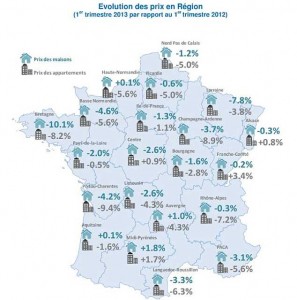
Perhaps that’s why this region is the only one in France showing positive growth in house prices in the first three months of 2013 according to first quarter statistics from National Federation for Estate Agents (FNAIM) in France:

This map shows a regional breakdown of values in the first quarter of 2013, compared to 2012.
The FNAIM also saw transactions towards the end of 2012 plummet 25 per cent due to the change in government with socialist leader Francois Hollande coming to power. Buyers and sellers were holding tight to see what happened to the market but the market in this region at least seems to be on the move again perhaps because buying a house in this part of France is seen as both a lifestyle choice as well as a sound financial investment.
Like this:Like Loading...
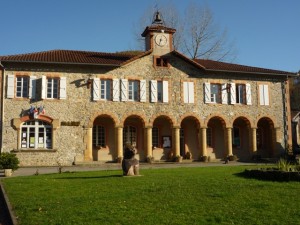
By nadia, on 10th May 2013 The Mairie in the village of Arbas As a foreigner, it has taken me a good ten years to really understand the importance of the local mayor and Mairie in France because we just do not have the equivalent in the UK. We knew that when we moved in to our village that we were supposed to introduce ourselves to our local mayor, which we duly did. When we were converting our barn, I became on first-name terms with him and he was so pro our renovation that he managed to fast-track our planning application through the official procedure. When all the parents in our small hamlet (14 houses) got together to sign a petition for the provision of some kind of lighting at the bottom of the hill for the children waiting in the dark for the school bus at 7am every morning, just three months later, a solar-powered light was duly installed.
But it is the smaller, every day things that go unnoticed by the locals (who take such a service for granted) but which always amaze me, coming from a country where there is not much in the way of local decision-making anymore. Hence, our Mairie employs two full-time people just to look after the commune. By that I mean, sweeping the roads, clipping the hedges and verges, clearing out the ditches and maintaining the lights, school flower boxes etc. Oh and clearing the roads of snow and ice in the winter – and this is a very rural community where houses are scattered up hills and along gravel track roads but this service happens without fail.
The efficiency of this ground-level service was brought home to me again this week. We have had a stray dog in the garden for about four days, a lost hunting dog but this time with no collar so I have no way of returning it to its owners. But I also didn’t want to start feeding it as we already have two dogs and two cats who were understandably upset by a stranger in their midst. So finally I asked my neighbour what I should do and he immediately called the mayor who organized for the dog to be collected, taken to the vet to be checked for a chip or tattoo and then either to be restored it to its owner or try to get him re-homed by the SPA (the animal centres in France who care for and re-home stray animals.)
It’s apparently the same for any problem in the commune – M. le Mayor is the first point of call and, if he can’t fix it, he will know somebody who can. France is hugely criticised on the world stage for its number of state employees and I think we all know that the costs of these have become untenable but I hope that it will be the legions of pen-pushers and paper shifters who go before these hard-working locals who really care about and have a reason to ensure that their communities are well looked after and just make life that bit nicer for everyone.
Like this:Like Loading...
By nadia, on 18th April 2013
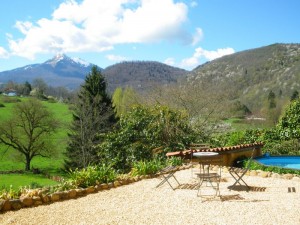
 Spring in the Pyrenees For most people, buying a house is not something they do regularly and it is easy to miss important details or forget to ask the right questions in the excitement, emotion and stress of the moment. So here are some things I look for and questions I ask when viewing properties or deciding on the right offer to make for clients:
- I always ask the seller why they are selling – not that you will always get the real answer but many are sellers are surprisingly honest!
- Look up and check the roof, are there any missing tiles or slates? Does it look in good condition or is it starting to sag? Does the guttering leak or can you see any gaps? The French are generally excellent at maintaining their roofs but a new roof can be a big and expensive job so, if it does need re-doing, it is worth being aware of this fact so that it can be used in negotiations.
- Check that the windows are in good order; whether there is any flaking timber or glass which is misting up if double glazed?
- Turn on taps and showers; is there good water pressure? Does hot water come through quickly? Are there any leaks?
- Do you have mobile phone reception? Can you get the other communications you need, such as satellite or cable TV and broadband?
- Do rooms catch the sun, or need extra light? Can you see condensation on the windows?
- Can you hear people around the house? Try walking upstairs and in a room when one of you stays below, is it really noisy?
- Make sure to take a look in the attic and especially at the beams to check for live beetle. The attic is also a good place to check if there is any insulation and in what state.
- Check what is included in the sale; often the French will expect to take everything when they go including light fittings and most of the kitchen so it is worth being sure on this point.
- Is the house private or overlooked by neighbours and, if overlooked, is there a way of securing privacy? If there are neighbours, I always take a sneaky peak into their garden to see what sort of state it is in and whether they have animals such as geese which can be smelly and also very noisy.
- I also ask whether surrounding fields are ‘constructible’ or whether the land is ‘agricole’ because, if constructible, you are likely to have new houses appearing next door.
- Check for damp – can you see or smell any? This can be dealt with but it is worth knowing about in advance and before moving in.
- Does the property have the space you need? If not, in theory, is there room to extend the property, either into the attic or into an adjoining barn and would it be possible to add an extra room or two to the house? For example, if the house is in the Parc National de l’Ariège or in a ‘Batiments de France’ area, any additional building is unlikely to get permission.
- Which way does the property face? South and east facing are the ideal but in this region, which gets very hot in summer, it is also important to make sure that you can use the north side or at least have a shady terrace in the summer months.
- Is there a fosse septique (septic tank) and, if so, is it aux normes (the requirements for septic tanks have recently changed in France and the majority of properties will need a new one or some work done to bring it in line with regulations.) Budget 3-5000 Euros for this.
- How is the house heated? This is becoming an ever more important question with the high price of gas and oil. I am increasingly looking for houses where some of the energy is provided by alternative means such as wood, solar or geo-thermal.
- How much are the Taxes Foncieres and Taxe d’Habitation – these are the property taxes and generally are much lower in France than in the UK and many other countries.
- If the house is near a road, how busy is it? I usually go back to a property on several occasions at different times of day to check on this if it might be an issue although, in this part of the world, the most usual noises are generally cow bells or logs being cut. I have, however, viewed a house which was in a lovely peaceful spot with only one close neighbour but I noticed that, hidden behind this neighbouring house, were what look liked kennels, albeit empty and sure enough, when I returned the following week, in the evening this time, the howling of hunting dogs from next door was unbearable.
- How close are the nearest shops? In France it is also worth asking whether there is a baker’s van or butcher’s van that passes through because most hamlets are served by these at least once a week and often three or four times a week.
- In the South West of France, it is also vital to find out if the road to the property is cleared of snow by the town or village services in the winter. If the property is in a hamlet and has village electricity and water and families living there, they almost certainly will be on the ‘deneigement’ route but I have found houses or barns in the mountains that are hidden up tracks which are definitely not cleared of snow automatically and so you run the risk of being cut off for the odd week in the winter which many people here do not mind but it is worth being aware that this might be a possibility before it actually happens.
- Most buyers tend not to have surveys in France but, if the house needs work, I often ask a builder to take a look at the general state of the house to ensure that there are not likely to be any nasty surprises after the sale.
- Finally I always have my camera and my notebook on every viewing as the camera often sees details that the eye misses at the time and I write copious notes to jog my memory about every detail or issue that I want to check further.
Viewing houses can be really enjoyable and exciting or equally can be (and often is ) very disappointing but, if you feel that you have seen the house for you, just take a bit of time to ensure that you know exactly what you are taking on and that you will be able to deal with it. A house is for life, not just for a sunny day after a glass or two of rosé at lunchtime. My main aim is to ensure that my clients get the best possible house at the best possible price and have thought through all the pros and cons and this should go for everyone thinking of buying a house in France.
Like this:Like Loading...
|
For further information please contact us:
|


You must be logged in to post a comment.