View from the Foothills of France

Some personal views on living, working,
bringing up family and making the dream happen in the most beautiful region of France. View from the Foothills of France also includes some personal and professional thoughts and tips on finding and buying the perfect property in the Ariège and Haute Garonne regions.

Archives

Categories

The Outlook for the French property market in 2021


What an extraordinary year this has been and like most sectors, the French property market was hit very hard by Covid with activity virtually at zero during the first lockdown in the Spring. The official French statistics body, INSEE, has reported that in the middle of ‘confinement’, there was a complete slump in French property transactions with virtually no sales being recorded between March and May 2020, mainly because most estate agencies and Notaire’s offices were closed.

This was in sharp contrast to the beginning of 2020 when the market had been growing steadily year on year for five years straight. According to the Notaires of France latest French property market analysis (link below) from 2015, the number of house sales transactions rose for 20 quarters at an average pace of between +3.5% and +5%. And in the 12-month period to April this year, the number of house sales topped one million for the first time ever (1,068,000 house sales).
https://www.notaires.fr/en/housing-tax-system/french-property-market/french-property-market-analysis

Since the lifting of the lockdown in France in mid-May 2020 however, the property market has been very busy. According to the same Notaires.fr report, from 2019 to 2020 the average selling price across France increased by +5.8%. The report goes on to say that ‘there has been a strong rebound in terms of post-confinement signings of pre-contracts, and notaries witnessed strong activity through to mid-August 2020′. The report continues: ‘ . . . the data clearly shows the resilience of the property market in France, despite the threats posed to the job market by the health crisis in the short term . . . notaries in most regions of France currently confirm the public’s very strong appetite for property purchases . . .’
INSEE Q2 2020 Housing Market France

The difference however in the current market as compared to the previous five years is that, post lockdown, the trend has seen a clear shift away from urban living to more rural areas. This is likely driven both by the wish for more space following confinement and the shift to working from home. Many people have discovered that they can just as easily work remotely and have now decided that they would like to continue doing so. This opens up a much larger geographical area of choice which is driving property decisions and it is very clear that space, natural environment and quality of life are being prioritised over the convenience of living in a city or town.

Whether this trend will continue in 2021 is hard to predict but certainly it looks as if there has been the kind of step change in the French property market that happens only once every few decades and it feels as if this one might be a permanent shift.

Whatever happens here in France and in other parts of the world, I wish you all a very happy and healthy 2021.

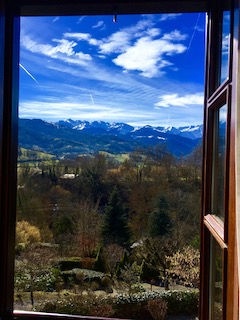


Happy Christmas from the Foothills

Christmas is always seen as a deadline for the French property market but this year it feels even more pronounced. This is mainly because it has been a very difficult year for most people thanks to Covid and hence most buyers and sellers are looking forward to a new start in 2021, either moving on to pastures new or into their new home. In addition, the end of the Brexit transition period on December 31st has put pressure on any buyers with a British passport because they need to be settled in France by the end of the year to be granted the same rights as they would have had pre-Brexit

Usually Notaires and agents go into hibernation in December but not this year; the pent up demand from sellers and buyers following both lockdown periods has resulted in a rush to sell and buy property and a backlog of work for Notaires trying to get contracts completed.

The build up to Christmas here this year feels very different too, mainly because all restaurants, cafés and bars are closed until 20th January as are the ski lifts. This is particularly difficult in this part of France where Christmas revolves around eating and drinking, big family gatherings and skiing or adventures in the mountains. At least the food markets have been allowed to open and, thanks to our privileged location, we know that we will always have a white Christmas because on Christmas Eve and on Boxing Day we can drive up into the mountains for some sledging, snow-shoeing, picnics and mulled wine.

I hope that 2020 has not been too difficult and wish you a wonderful Christmas, bonnes fêtes and a very happy 2021; may all your property dreams come true.

Health Care in France


The French healthcare system is considered one of the best examples of universal care at affordable rates – but how does it work?

The French health care service is provided mainly by the state through various state funds accessed by a card called a carte vitale which is rather like a credit card given to everyone in the French healthcare system. However, part of the cost of treatment and drugs is covered by a form of private health insurance which will depend on your level of income. If you are earning the minimum wage, then the majority of the cost of your healthcare will be covered by the state but, over this level, the general coverage is approximately 70% of the cost with you making up the final 30%. Most people do this by having an annual health insurance policy known in France as a mutuelle.

There are numerous insurers to choose from and, as with all types of insurance, a wide range of policies with varying degrees of cover and premiums. Basic packages tend to cover hospital costs and medicine, but you can choose to add things like dental costs.

This complementary health insurance should not be confused with private health cover in the UK or the US. Although bought by the individual, it simply assists financing the personal contribution element of French healthcare. It is inexpensive, does not guarantee faster treatment times and is not affiliated to private practitioners or clinics.

In terms of payment, the individual pays for treatment and the relevant state fund is automatically alerted via the carte vitale system. The percentage refunded by the State is then indicated to the relevant mutuelle which calculates accordingly how much it will reimburse.

For those not in the French healthcare system, Europeans are covered by a reciprocal agreement and for anyone outside of Europe private healthcare is available.

If you are planning a move to France, please get in touch for help with your property search and I can also recommend you to my partners for other help and advice with moving to France: nadia@foothillsoffrance.com

Obtaining planning permission in France

In the last few years, I have noticed an increase in buyers looking for either plots of land to build their own grand design or for rural barns that can be converted into flexible living accommodation. While in theory, this seems like a good option and, in the past has been relatively simple in France, planning laws have become much more restrictive, particularly in the countryside so it is worth being aware of the planning process in France before going down this route.

Buying a plot of land and building a new property
The planning regulations concerning building property in the French countryside are becoming tighter and new construction in open countryside is generally not permitted in order to protect farmland and agriculture as well as the natural environment.

There are however always exceptions because, while the planning laws are defined at national level, it is at the local level that these laws are interpreted. This means that the decision comes down to the local authorities as to what type of planning they allow. These decisions are determination by the rules that apply to the local plan, known as the Plan Local d’Urbanisme (PLU) or the more limited Carte Communale, which is more common in rural areas. These plans outline the areas where new residential buildings are allowed and where they are not within set boundaries. These will include various zones for example; constructible zones, non-constructible zones, woodland zones and agricultural zones.
In addition, there may also be in place a risk prevention plans called Plan de Prévention des Risques (PRR), which are becoming more important in terms of zones where building is and is not allowed relative to perceived natural dangers such as flooding or seismic zones.

Barn Conversion
Most local plans can authorise change of use of a former agricultural building such as converting a barn to living accommodation provided such a change of use does not compromise agricultural activity or the quality of the landscape.
However, in giving consideration to an application or change of use, the commune must also take into consideration the condition of the existing building, the services available, and changes that may be envisaged to the volume of the building. In practice this often means that a barn attached to an existing dwelling will be given planning permission whereas, for example, an ancient barn on its own with no utilities close by will not. In addition, in protected rural areas such as the national park of the Ariège Pyrénées, it is now very difficult to get planning permission to convert a mountain barn into living accommodation as the rules to protect the natural environment take priority. This is why mountain barns which have already been given ‘habitation’ status or already have outline planning permission from earlier are very hard to find and very expensive.

Extensions
Planning law is generally most favourable in the countryside when it comes to extensions to existing residential dwellings. Existing homeowners in agricultural or natural zones have the right to build ‘annexes’ and a make change of use to their property. This is, however, generally restricted to an extension that is smaller than the existing building and attached to it.
Separate garages, garden sheds and other independent annexes and swimming pools are not covered, but most local plans allow for such development. In all cases, development will remain subject to not infringing third-party rights, such as overlooking or proximity to the perimeter of the property.

For anyone looking to design a bespoke house, certainly a plot of land appears to be the most obviously appealing prospect but it is also the most difficult in terms of finding the perfect plot and getting planning permission. Hence a better option might be to look for a property that has an attached barn that could be converted or for a small property with the potential for conversion.

If you need help with your property search, please get in touch: nadia@foothillsoffrance.com