View from the Foothills of France

Some personal views on living, working,
bringing up family and making the dream happen in the most beautiful region of France. View from the Foothills of France also includes some personal and professional thoughts and tips on finding and buying the perfect property in the Ariège and Haute Garonne regions.

Archives

Categories

Where to live in south-west France

The Ariège, the Haute Garonne and the southern Gers stretch south and west between Toulouse and the Pyrenees to make up one of the most enticing and enchanting regions in France. This is an area that really does have it all, from rich culture, history, natural wonders, stunning landscapes, mountains, lakes, rivers and valleys, and gastronomic excellence. Whether you are looking for the urban sophistication of Toulouse, the charm of traditional French village life or the unspoiled natural valleys and pastures of the Pyrenees, you will find it here in one of the most beautiful regions in Europe

With 2,000 hours of sunshine on average per year, this is also one of France’s sunniest regions. Spring comes early with the spring rains ensuring a lush and green landscape followed by the intense sunshine of July and August which is often very hot and then a beautiful autumn season which continues until the first mountain snowfalls which often remains on the highest peaks through until the end of June.

The green valleys and mountains are a huge attraction for those hoping to enjoy the great outdoors. In summer the whole region is an accessible paradise for walkers, cyclists, horseriders and climbers who come to enjoy the beautiful and unspoiled landscape. In winter, when the Pyrenees are blanketed in snow, these are replaced by skiers and walkers with raquettes (snow shoes) or families with sledges.

This region is also a fantastic location for exploring not just south-west France but also Spain and Andorra. Within easy reach are mountains, wild Atlantic beaches or the sunny Mediterranean coastline. You really can sit on a beach, ski in the mountains, eat tapas in Spain and explore the markets and historic towns and cities of rural France all in a weekend.

If you would like some help or advice with your property search, please get in touch: nadia@foothillsoffrance.com

Furnishing your new home in France

Once you have bought your home in France, whether that be a permanent home or a holiday house, you will need to think about furnishing it. This is easy if you are coming from somewhere else within Europe as there are no restrictions to moving goods around. In addition, if you are moving permanently to France from a non-EU country (and France will be your principal residence) then you should be exempt from duty and taxes on your personal belongings, as long as you have the correct paperwork. This includes an inventory of all the household items you are bringing to France, a customs form and proof that you are moving your primary residence to France. There are also some exclusions to the tax exemption such as motorbikes, bikes, cars, trailers, horses and professional or trade equipment.

If, however, you are buying a holiday home in France and live outside of Europe, including the UK, it is more complicated, and you cannot simply bring your existing furniture and goods to install them in your new property. Furniture and household goods are now liable for customs and VAT charges, and you need to be able to provide receipts for the goods you are importing or proof of their value so that the charges can be calculated. There is, however, an allowance of goods that each person can bring into France up to a value of €430 if you are arriving by plane and €300 by car without a need for a customs declaration.

Luckily it has become easier in the last few years to furnish your holiday house in France as there are now more homeware shops and places selling home equipment. In addition, you might find that the people you are buying the house from can be persuaded to sell some of their furniture, white goods and garden equipment, especially if it is a holiday house already or they are downsizing or moving abroad so this is always my preferred option for clients if possible. And it also means that you can move straight in and start enjoying your new home immediately.

If you need help with finding a property in France, please get in touch; nadia@foothillsoffrance.com


Creating a sustainable swimming pool

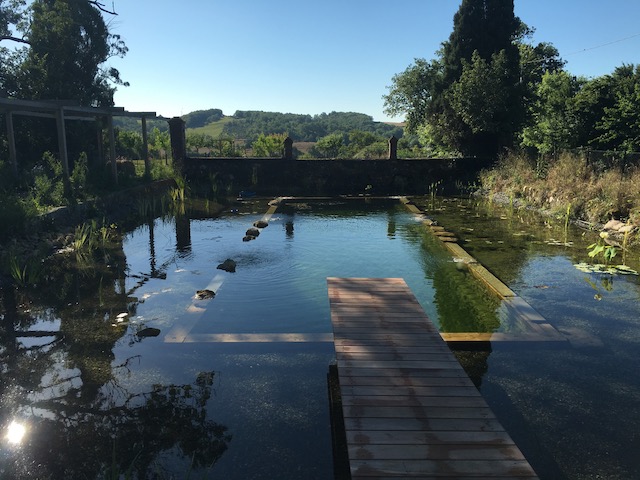
A natural swimming pool

Swimming pools are often high on the wish-list of people looking to buy a house in France and they can be a great source of fun for family and friends. But they can also be an expensive luxury, not only in terms of cost but also effects on the environment thanks to the energy needed to heat and maintain a pool, the chemicals to keep it clean and, of course, the water to fill it and keep it topped up. There are, however, plenty of ways to make it more energy efficient and sustainable.

1. Eliminate chlorine

Chlorine is a dangerous chemical that is a carcinogen and has been linked to asthma, rashes, skin irritation, headaches, and other problems. In addition, chlorine forms a gas that can be inhaled by people who are not even swimming. The best way to ensure your swimming pool is environmentally friendly is to use the alternative of copper/silver with oxygenation instead of chlorine or salt to purify the water. This is a cheaper and safer method of making your swimming pool water pure – pure enough to drink.

Another popular choice is to add a saltwater generator which converts the salt you add to chlorine but in much smaller quantities. This makes the water friendly on the skin and eliminates the chlorine smell so that people with respiratory problems such as asthma are less effected by the smell of chlorine. The water is also clearer, feels silkier and smooth.

2. Use eco-friendly technologies

Harness the sun
One of the most eco-friendly and cost-effective ways to run your pool is to use solar power. Installing 2-3kW of solar panels is sufficient to cover the cost of running the pool pump, filter etc especially if you set the pool pump on a timer, generally between 10am and 3pm in summer to ensure that you are using your solar power for energy use.

Invest in a thermal pool cover or solar ‘bubble blanket’
Covering a pool when it’s not in use is a simple yet effective way to reduce environmental impact by retaining heat, reducing evaporation, and maintaining chemical balance. Various covers are available, the most effective being thermal covers designed to withstand strong UV so that they last longer and have greater insulating properties. Alternatively, solar covers or bubble blankets contain air pockets that absorb heat from the sun and transfer it to the water, heating your pool. A good solar cover can heat your pool by up to eight degrees, however they are not as effective as thermal covers at retaining heat overnight. Typically, more affordable than thermal covers, solar covers tend to have a shorter lifespan.

Don’t overuse the pump
A pool pump running 24 hours a day can produce as much greenhouse gas as a large car over a year. To reduce emissions and costs, it is therefore important to use a timer to manage your pump’s running time and run it off-peak if possible. Many pool professionals recommend that pumps run anywhere from 6- 12 hours per day but most debris is only found at the top of the pool meaning you can run your pump for less time. To keep your pump running as efficiently as possible it is also recommended to regularly clean the skimmer basket, pump basket and filter and keeping your intake grates clear of debris.

3. Water neutral pools

For pool owners who are concerned about water and energy usage, water-neutral pools offer an easy solution. Water-neutral pools use a combination of water-saving and water-harvesting devices such as water tanks to collect rainfall to top up the pool, and backwash-minimisation systems to minimise environmental impact by reducing the amount of overall water needed to maintain a swimming pool.

4. Natural pools

A natural swimming pool is completely chemical free and takes inspiration from nature to help filter any harmful bacteria and dirt. Natural pools rely on biological processes to purify the water using aquatic plants native to the area, and thus act as part of the local ecosystem. Traditionally, a natural swimming pool consists of a swimming area and a planted area. The planted area is essentially a built-in natural ecosystem made of plants that are low maintenance and ensure that the water remains clean and clear and it is this “regeneration zone” that allows the pool to essentially clean itself. Water from the pool is circulated into this zone, where aquatic plants filter it and boost oxygen levels. Strategically placed rocks and gravel also assist with the purification process. The water filters through the plants which absorb any bacteria and release the clean water back into the swimming area.

Unfortunately, natural pool installation tends to cost about twice that of traditional pools, but you will save money on chemicals and also on electricity, as most pumps are not pressurised, and thus use much less energy. In the long term, therefore, a natural pool can also be cost-effective and cheaper to run than a traditional pool.

If you need help to find and buy your dream home in France, please get in touch: nadia@foothillsoffrance.com
 

Escape to France

Last month, the highest number of searches in internet history were made in Britain for the term “move abroad” on Google. Searches rose by 1000% in April, according to data from emigration specialist Reiss Edwards.

More than 400,000 British residents emigrate each year and it looks like this number is only going to increase thanks to inflation and rising costs driving down standards of living in the UK, pushing some Brits to look for an alternative way of life and a more affordable country in which to settle for a better lifestyle.

Britain has been faced with a gradual rise in the cost of living that began with Brexit followed by the pandemic, and which has been amplified enormously in the last couple of months with inflation, supply problems and mortgage interest rate rises. This means that many people who thought they had a decent job and income are suddenly finding themselves struggling to cope with the rising costs and the fast-paced, consumer pressures that come with living in the UK. Combine this with a seemingly endless cycle of bad news and a change of priorities thanks to living through the uncertainties of Covid and and it is not surprising that so many people are starting to think that there must be a better way to live and that it is perhaps time for a new start.

Of course, there are also inflationary pressures in France and prices here are also rising, albeit at a slower rate from a lower baseline but it is not having the same impact on people’s quality of life. The property market in France is more stable and not so affected by the vagaries of the wider economy thanks to less pressure on housing and the fact that most people take out a 15- or 20-year fixed rate mortgage. This means that property is still affordable, mortgage rates low as are property taxes and energy prices are also capped plus things like childcare are much cheaper in France, as is university and schooling. On a day-to-day basis, local produce is good value, home cooking still the norm and the pace of life slower whilst quality of life remains a priority. And of course, in this part of France, the better climate means that it is more practical to walk and cycle rather than drive and to use the countryside as a free leisure park which also makes for a lower cost of living.

Ultimately moving somewhere with lower house prices, lower mortgage rates and a lower cost of living can mean a better quality of life. Equally this comes with a sense of uplift in difficult times and a feeling of opportunity and freedom; that of choosing how we want to live our lives rather than feeling we can never get off the hamster wheel of working simply to pay our ever increasing costs.

If you would like information or advice about moving to France and finding the right property for you, please get in touch: nadia@foothillsoffrance.com