View from the Foothills of France Some personal views on living, working,
bringing up family and making the dream happen in the most beautiful region of France. View from the Foothills of France also includes some personal and professional thoughts and tips on finding and buying the perfect property in the Ariège and Haute Garonne regions.
|
By nadia, on 5th April 2011
…this is according to television presenter Kate Humble who is leading a campaign to get children back in touch with nature – and I couldn’t agree more. Of course, most of us realize that it is better for children to be outside in the fresh air with space to run around and nothing but their imagination and nature’s bounty to entertain them than to be sat indoors in front of a television or computer screen. But it certainly bears repeating and often as, apparently, the latter is how more and more of the children in the UK are spending their time.
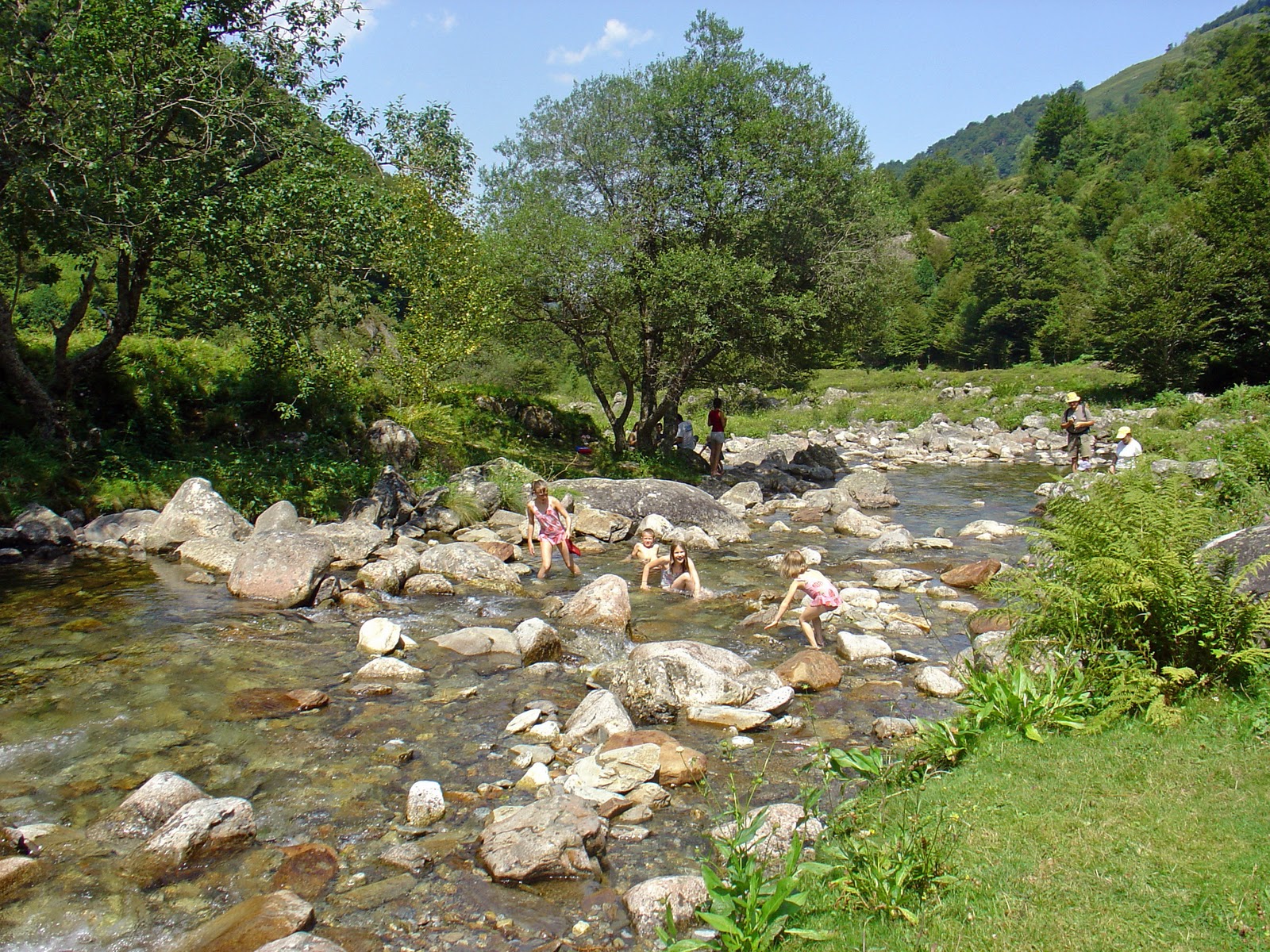
Luckily rural France provides the perfect antidote to this; children here really do spend time in the countryside and they do understand and interact with nature – even if that happens to involve hooking it on the end of a fishing line! Maybe this is because France is predominantly a rural country with so much countryside and unspoiled nature available on the doorstep or maybe it is down to the attitude of us parents. In the UK, as Clive Aslet of Country Life Magazine points out, although a child’s postcode:
‘may locate them in a village, their lives will probably be suburban. Parents, worried about paedophiles and motor vehicles, won’t allow them to bicycle along country lanes. Instead, they’ll drive them everywhere by car. Shopping will be done at a supermarket that looks exactly like the ones in cities, except for being bigger and surrounded by more concrete. If the family goes on an outing, it will be to somewhere stage managed, with parking, toilets, noticeboards and disabled access.’
I think that there is a different attitude to children here in France; they are less molly-coddled, expected to be a functioning part of society and are given credit for having some innate common sense and self-preservation – in short, they have more liberté. I find it as difficult as any parent to know when is the right time to step back and let my children manage on their own and I can only speak of my own experiences, what I see happening around me but certainly many of the pupils at the primary school my daughter attends either walk or cycle to school on their own. In our small hamlet, the children come and go as they please from the age of 5 or 6; they visit their friends in neighbouring houses, take off on their bicycles on the quiet roads around the hamlet or make dens in the surrounding fields and woods. Of course, each family keeps an eye on everyone else’s children as much as they can but we generally have no real idea of what they are up to or even where they are and have to ring a bell to summon them back for meals. They are probably doing dangerous things like climbing trees or making towers of hay bales but it is through taking a few risks that children learn to be independent and develop into rounded people, better at dealing with the varied situations that life might throw at them.

Certainly for me, one of the very best things about living in France is being able to give our children the chance to grow up in the freedom of the countryside rather than become sucked into the fake world of computer games, television stars, fashion and beauty. Of course these things will become more important to the children as they become teenagers but at least they will have had the fun of playing pooh sticks, damming streams, getting muddy and building their own worlds with branches and bracken. Hopefully they will be able to recognize birds, insects and trees and, most importantly, to understand the natural world and how it works because this is the generation that is really going to need those skills and understand how important they are if the countryside is going to exist for future generations.
By nadia, on 23rd March 2011
I have a number of clients from all over the world in the process of buying property here in the Ariège, Haute Garonne and the Gers right now so I thought I would blog briefly on how the house buying process works in France.
Buying a house in France is usually very straightforward, well-regulated and generally far less stressful than in many other countries, particularly the UK. This is a very brief outline of the process but for more detailed information take a look at this article on the Frenchentree website.
Once your offer on a French property has been accepted, you will sign a Compromis de Vente with the vendor drawn up by the local Notaire. This is a written document and binding agreement between the vendor and the buyer which means that gazumping is pretty much non-existent in France. The Notaire is completely impartial, working for the government and often acts for both buyer and seller although I can also recommend an English speaking Notaire if preferred. You will usually be asked to pay a deposit of 5-10% of the agreed price on signing the Compromis de Vente.
Once you have signed, the house is taken off the market and you know that you have secured your home in France. There is a cooling off period of 7 days however for the buyer (not for the seller) to allow you to pull out without penalty and to give you peace of mind.
It then takes around two to three months for the Acte de Vente – the deed of sale – to be drawn up by the Notaire so as to be ready for the final signatures between the parties. The Notaire has to conduct planning and other searches and enquiries with the local authorities including ensuring that the necessary reports have been done by the vendor. These include lead, asbestos, termites, gas, electricity and energy reports which are all grouped together in a single report called the Dossier de Diagnostic Technique or the DDT.
Once the Acte de Vente is ready, the vendor and buyer meet in the Notaire’s office to sign and to pay the balance of the purchase price, legal fees and taxes to the Notaire (this money must be with the Notaire by the date of signing so, if transferring from abroad, allow at least 10 days to two weeks for the money to clear.) The Notaire’s fee is usually between 2-8% of the ‘net’ property price, the majority of which is effectively stamp duty that goes to the government. The estate agent’s fees are generally around 5-6% of the purchase price and sometimes these are included within the purchase price while other times they are quoted separately. House insurance must also be arranged by the time of signing. I usually advise my clients to visit the property on the day of (before) signing to ensure that the house has been left as agreed because the French do have a tendency to take everything with them, including the kitchen sink!
And finally you will get the keys to your new house. Congratulations, you are now the proud owner of your dream home in France. Enjoy.
By nadia, on 11th March 2011
First find your property!
I sometimes wonder how anyone manages to buy a house in this region without using a property finder. I live and work here, I know all the agents and still the whole process of finding and getting to see the right property is sometimes a bit like trying to get blood out of a stone.
Firstly, despite the fact that I visit every agent most weeks to remind them exactly what my current clients are looking for, still there is hardly a single agent who gets in touch when they take on a new property meeting my client’s brief exactly (barring the odd exceptions who work very hard on my behalf.)
Secondly, not all agents are as keen as I am to head out and view potential properties. Yesterday I went in to see an agent because I had noticed that he was advertising a new property which looked very interesting for one of my current clients (there is no point just telephoning – everything works better face-to-face here.) The property – a mountain barn – appeared to fit my brief but the most important thing that I wanted to find out was where it was situated – location as we all know being the vital element, especially for mountain properties. The agent told me in which valley it was located (one of my favourite) and then suggested I could go and take a look and pointed a finger at a map as a vague illustration as to where I might find it.
I have fallen for this ploy before – and then spent a few frustrating hours trying to work out exactly which isolated barn I am supposed to be looking at and whether I am actually supposed to trespass and break in to get a proper look. So I suggested that maybe he could even take me to see the property and perhaps take along a key so I could look inside. I could see that this was now all getting a bit much for him for one day and he was finding me a bit demanding so I suggested that I could make an appointment for a viewing the next day. With much sighing and sucking of teeth, he took his feet off the desk and opened his diary to check just how busy he was the next day. The page was completely blank! So I said I could be there at 9am at which point he really put his foot down and said that he might manage 2pm (nothing happens before lunch here!) But at least we had a date.
Or that’s what I thought. So the next day, there I was at 2pm outside the locked offices with not a soul in sight. By 2.15 I was starting to get fed up and about to leave when the agent arrived looking slightly non-plussed as to what I was doing there. I reminded him and we spent the next 30 minutes looking for a key and directions to said property while he tried to persuade me that it really wasn’t worth the trip. By 3pm we were finally in the car but 20 kilometres later the agent then started fumbling around in his pockets and admitted that he seemed to have misplaced the key. So back we went to the office where we discovered he had dropped it on the road. It was now 3.30pm and the agent looked at his watch and said that it was now too late for him to go with me to see the property as he had an appointment at 4.30 and wouldn’t be back in time if he did.
Which was how I found myself yesterday up on a lovely mountain plateau, exploring various paths that may or may not lead to a perfect mountain barn. Luckily I had seen a photo and had a good idea of the location but, when I did find what I thought must be the right place, I was slightly apprehensive that I might be trying to unlock the door to the wrong house entirely, perhaps with the bemused owner watching me from the kitchen window. Luckily however, that wasn’t the case and this particular property turned out to be very much worth the trip – two well-looked after barns, one of which had been renovated completely, in a great plot of land with lovely views and very peaceful. There was even vehicle access which is certainly not a given for many of these mountain properties.
Two perfect mountain barns – definitely worth a viewing
Of course many properties I visit do turn out to be not worth the effort – I usually see at least 10 properties that transpire to be no good for every one that makes it to a property report and possibly the short-list. Usually I will view up to 50 – 80 properties during one search, only 6-10 of which are likely to reach the short-list. But this property might just prove to be ‘the one’ which is why – in my opinion anyway – every property that sounds on paper that it fits the brief, is worth a visit.
This agent is the perfect illustration as to why the English property invasion is yet to arrive in the Ariège – and why I knew there was a need here for a property finder on the spot, working for the buyer not the seller and trying to change the attitude of the ‘old-school’ estate agents here. Whether the agent will then have deserved his commission if this does turn out to be ‘the one’ – well that’s another debate.
By nadia, on 26th February 2011
Come on England – Come on France!
I am sitting here watching (well half watching!) England play France in the Six Nations along with the very excited men in my life – even the three year old is jumping up and down cheering as if he knows exactly what is going on. If he does, he is doing much better than me!
What strikes me as odd about this situation is that all of the children have now lived in France longer than they did in England – indeed the youngest was born here. They go to French schools, have French friends, play for French sports clubs – they even like to drink their hot chocolate from a bowl. And yet, they are more patriotic and proud to be English than just about anyone I know. And, from talking to other expats, it appears that this is a common tendency among expat children – there is something about living away from your home country (however happy you are to be abroad) that makes us suddenly become fiercely loyal to Britain; huge fans of the royal family, marmite, warm beer and Bruce Forsyth. Well maybe not the last but you get the drift. Memories of England are suddenly rose-tinted and we are back living in the ‘great days’ of the Empire. Thus here we are in a very French part of France, in our very French house, living our very French lives and yet cheering on ‘our boys’ in white (with the pretty red rose) back in grey and rainy Twickenham. It does all seem rather surreal!
Here in this part of south-west France, rugby is THE sport and French fans are fanatical about their local teams. Rugby is one of the most popular sports played in France, with more than 200,000 registered players playing at its 1,700 clubs and the level of interest in the support at club level is very high. Unlike England, where rugby is strongly associated with the middle classes and public schools, French rugby possesses no elements of elitism. In France, the game has solid foundations among the farmers and labourers of the southwest; even if the Parisian clubs have a reputation for attracting playboys and city-slickers. Matches attract significantly higher crowds than in the UK and unlike in England, Scotland and Ireland rugby has an equal following to football. In France it is rugby that is the beautiful game.
One of the most successful clubs in the history of French rugby is our local(ish) team in Toulouse, Stade Toulousain who have won the French Championship 16 times. They have won the European Cup on three occasions, making them the most successful European rugby side of all time: www.stadetoulousain.fr
Personally, I am not really sure who I want to win; if the English win, I will have very elated children and miserable neighbours, but if the French win, I will have happy neighbours and dejected children. I guess the most I can hope is that, whatever the result, there is a sense on both sides of what the French call ‘le fair play.’
|
For further information please contact us:
|