View from the Foothills of France

Some personal views on living, working,
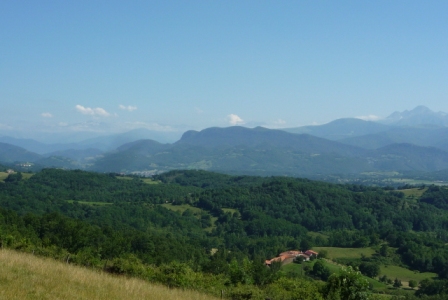
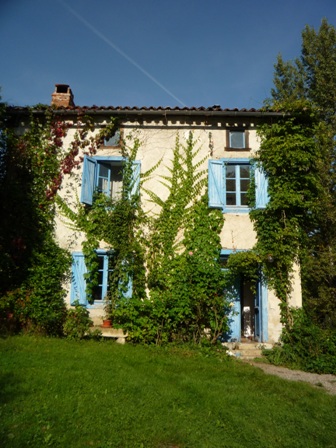
bringing up family and making the dream happen in the most beautiful region of France. View from the Foothills of France also includes some personal and professional thoughts and tips on finding and buying the perfect property in the Ariège and Haute Garonne regions.

Archives

Categories

The perfect time to bag a bargain

There are always some incredibly good value properties to be had in this region but right now, there are some fantastic bargains – the unintended consequence of the change in the law ‘plus value’ or capital gains tax. This won’t alter anything for non-French residents with second homes in France, nor for those of us who have our permanent homes in France but it is having a big effect on the French property market right now, particularly here where many locals own second and holiday homes.

In the past, French owners of second homes would have had no capital gains tax to pay on the sale of these properties after 15 years and a generous taper allowance when selling before 15 years but this law is due to change on the 1st February meaning that capital gains tax will be due for all second properties owned by French residents for less than 30 years and with a much reduced taper allowance up to the 30 years.

Hence suddenly I am seeing a lot of fantastic properties coming onto the market with owners very keen to sell and very willing to take offers if it means that they will complete by January 31st. In fact, they are in many cases putting their property on the market at less than it has been valued for but only until the end of January; here’s an example of a private sale;

Bien estimé par notaire et agences 150 000€, cédé à 137 000€ en raison nouvelle taxe sur la plus valu.
Au premier février cette offre ne tiendra plus. (Valued by notaires and agencies at 150,000 Euros but offered at 137,000 Euros because of the new capital gains tax. From 1st February, this offer will no longer be available.)

Hence, for anyone who is looking for a bargain (and let’s be honest, who isn’t?) this, along with historically low interest rates, is making the next few months look like a very good time to be buying a house in the Midi-Pyrénées.

Scaling the heights

The Pic du Midi

One of the lovely things about living in the foothills of the Pyrenees is the ever-changing views; the mountains have a life of their own and like to put on a good show. Today we woke up to a dusting of fresh snow on the top of the highest peaks which completely changed the landscape and the perspective and motivated us to make a quick trip up to one of the highest peaks to take in what must be one of the best views in France.

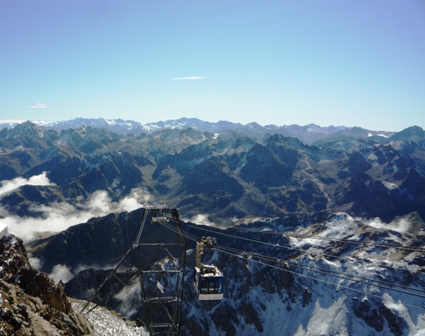
This is an ideal time of year to head up into the mountains – the air is clear and cool in the mornings but beautifully warm in the afternoons and the clarity of the light is almost unreal. The highest easily accessible peak in the Pyrenees is the Pic du Midi where a journey of two cable cars whisks you up to 2877 metres. (The actual highest peak in the Pyrenean range is on the Spanish side, Pico de Aneto at 3406 metres.)

The cable car to the summit

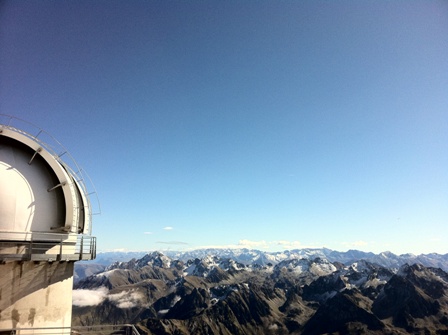
The Pic du Midi is visible from all over this region, particularly driving around the Haute Garonne, its telescopes and large aerial making it stand out clearly from the other peaks. Most people take the trip to the top just for the view and it is certainly worth it for that alone although also at the summit you will find the highest museum in Europe. More serious star gazers can book into the small hotel (just 19 guests) for an overnight stay with conducted tours and use of the telescopes – as well of course, gourmet dining. At night from the top, they say you can see the lights all the way from Biarritz to Barcelona.

For me it is just great to be driving around looking at the Pic du Midi every day and knowing what it feels like to stand up there, on the top of the world.

One of the telescopes and the view from the top


Making the dream happen

I have just completed a search and agreed a deal on a fantastic property for some lovely clients. They could not be happier and neither could I – when everything clicks with a search and the people and property fit like a glove, it is an immensely satisfying feeling.

I had a strong inkling during this search – as I always do – which property would really work for these clients but of course, buying a home is a very personal and emotive experience so it is never possible to make exact predictions nor do I want to influence my clients other than in a professional capacity. However, this is a couple who have really planned this move down to the last detail and know exactly what they want to achieve and how they are going to do it and they definitely have the energy and vision to see it through so it is very exciting to be part of this; another step on the way to their new life.

My main motivation for setting up this property finding business was to help people aquire the best possible property for them, while ensuring they avoid the pitfalls and the stress so that the whole process becomes a pleasure. What a great feeling; knowing you have helped someone’s dream come true.


La Rentrée

La Rentrée has just taken place here and it is a big event in France which is probably why they have a word for it and we don’t, relying instead on the rather more prescriptive phrase ‘back to school’. But here it doesn’t really just refer to the children, rather for everyone returning to work after the summer. Of course, not all of us have had the luxury of taking the whole of July and August as holiday like the children but most friends and neighbours here seem to manage to be off for August and even those who are working tend to do so in, shall we say, a rather relaxed and laid back way! There is no doubt that the summer months here have a very different feel about them to the other months of the year which is no doubt why it is important to have La Rentrée to snap everyone back into a slightly more dynamic work mode.

When we first moved to France, it was two days before the rentrée and the first experience of French school for our eldest daughter who was six at the time; I don’t know who found that first day more traumatic, her or her parents. As it turned out, the children adapted to life in France remarkably quickly and easily which usually tends to be the case. When worrying about moving children to France, it is probably worth bearing in mind that children are pretty resilient and very flexible; they are less self-conscious than adults and will mix with local children without worrying too much about their language abilities.

The French school system, albeit very traditional if not old-fashioned, is generally renowned for setting high standards for its students, as the French take education very seriously.  School is not compulsory in France until children are 6 years old although almost all 3 year old children are enrolled in the voluntary écoles maternelles, often attached to the primary school. Primary school hours are generally from 8.30/9 am to 4.30/5 pm with lunch between 12 and 2pm when many children go home. On Wednesday afternoon there is no school and in many departments schools have Wednesday off completely. The good news for working parents is pre and after school clubs are the norm in France and usually excellent.

At college (secondary school for 11-15 year olds) maths and French are still the most important subjects and practical subjects that we are used to in the UK, such as home economics, woodwork and drama are not common in France where they concentrate on more academic subjects. Homework increases dramatically at this stage but Wednesday afternoons are still free for sports and other activities. As in the UK, students can leave school when they are 16, but approximately 94% go on to further education. At the end of the 3ème (aged 14-15), students take an examination known as the Brevet which, like GCSE’s, is a knowledge test for the end of this section of the child’s education. The results and choices made at this stage will affect the type of Lycée (sixth form) to which your child will next progress.

The final school years (15-18) are taken in the Lycée culminating in the final Baccalauréat (Bac) examination which is an automatic entrance qualification to French university. Students also have the option of working towards vocational certificates such as Certificate d’Aptitude Professionnelle (CAP) and Brévet d’enseignement professionnelle (BEP), which either lead to a job or a vocational technical Bac.

To go to university in France, the only entrance requirement is normally to pass the Bac and universities must accept anyone who has passed. As a result, there is generally high competition to enrol on the course of your choice at the university of your choice. University students don’t pay tuition fees and many attend the university closest to their home.

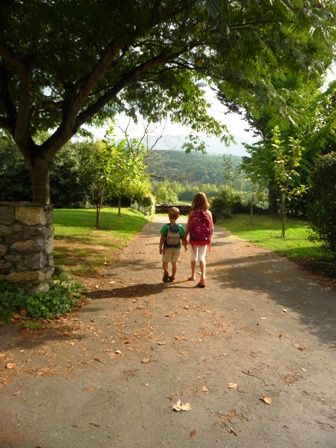
School this morning

Like any education system, the French method has its strengths and weaknesses but, if nothing else, surely the one of the most important parts of bringing up children is to open their eyes to other cultures and help them to understand that different countries have different ways of doing things; that there is not necessarily any one right way. Thus hopefully, moving children to France at least widens their horizons and expands their aspirations. And, if nothing else, it gives them the great advantage of being completely bilingual with a perfect French accent – something us parents can only dream of.