View from the Foothills of France

Some personal views on living, working,
bringing up family and making the dream happen in the most beautiful region of France. View from the Foothills of France also includes some personal and professional thoughts and tips on finding and buying the perfect property in the Ariège and Haute Garonne regions.

Archives

Categories

La Rentrée

La Rentrée has just taken place here and it is a big event in France which is probably why they have a word for it and we don’t, relying instead on the rather more prescriptive phrase ‘back to school’. But here it doesn’t really just refer to the children, rather for everyone returning to work after the summer. Of course, not all of us have had the luxury of taking the whole of July and August as holiday like the children but most friends and neighbours here seem to manage to be off for August and even those who are working tend to do so in, shall we say, a rather relaxed and laid back way! There is no doubt that the summer months here have a very different feel about them to the other months of the year which is no doubt why it is important to have La Rentrée to snap everyone back into a slightly more dynamic work mode.

When we first moved to France, it was two days before the rentrée and the first experience of French school for our eldest daughter who was six at the time; I don’t know who found that first day more traumatic, her or her parents. As it turned out, the children adapted to life in France remarkably quickly and easily which usually tends to be the case. When worrying about moving children to France, it is probably worth bearing in mind that children are pretty resilient and very flexible; they are less self-conscious than adults and will mix with local children without worrying too much about their language abilities.

The French school system, albeit very traditional if not old-fashioned, is generally renowned for setting high standards for its students, as the French take education very seriously.  School is not compulsory in France until children are 6 years old although almost all 3 year old children are enrolled in the voluntary écoles maternelles, often attached to the primary school. Primary school hours are generally from 8.30/9 am to 4.30/5 pm with lunch between 12 and 2pm when many children go home. On Wednesday afternoon there is no school and in many departments schools have Wednesday off completely. The good news for working parents is pre and after school clubs are the norm in France and usually excellent.

At college (secondary school for 11-15 year olds) maths and French are still the most important subjects and practical subjects that we are used to in the UK, such as home economics, woodwork and drama are not common in France where they concentrate on more academic subjects. Homework increases dramatically at this stage but Wednesday afternoons are still free for sports and other activities. As in the UK, students can leave school when they are 16, but approximately 94% go on to further education. At the end of the 3ème (aged 14-15), students take an examination known as the Brevet which, like GCSE’s, is a knowledge test for the end of this section of the child’s education. The results and choices made at this stage will affect the type of Lycée (sixth form) to which your child will next progress.

The final school years (15-18) are taken in the Lycée culminating in the final Baccalauréat (Bac) examination which is an automatic entrance qualification to French university. Students also have the option of working towards vocational certificates such as Certificate d’Aptitude Professionnelle (CAP) and Brévet d’enseignement professionnelle (BEP), which either lead to a job or a vocational technical Bac.

To go to university in France, the only entrance requirement is normally to pass the Bac and universities must accept anyone who has passed. As a result, there is generally high competition to enrol on the course of your choice at the university of your choice. University students don’t pay tuition fees and many attend the university closest to their home.
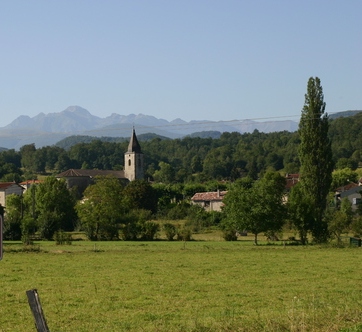
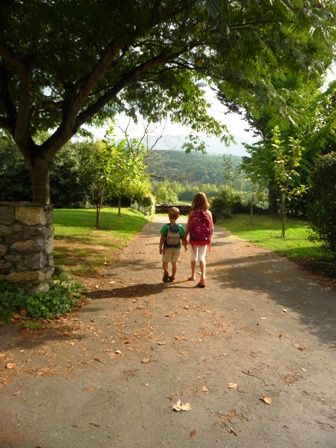
School this morning

Like any education system, the French method has its strengths and weaknesses but, if nothing else, surely the one of the most important parts of bringing up children is to open their eyes to other cultures and help them to understand that different countries have different ways of doing things; that there is not necessarily any one right way. Thus hopefully, moving children to France at least widens their horizons and expands their aspirations. And, if nothing else, it gives them the great advantage of being completely bilingual with a perfect French accent – something us parents can only dream of.
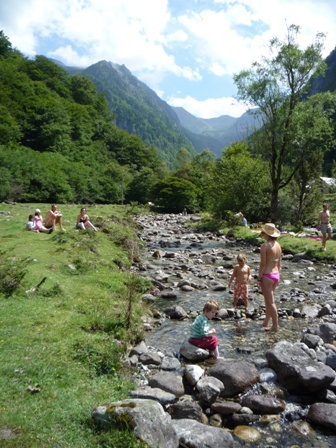
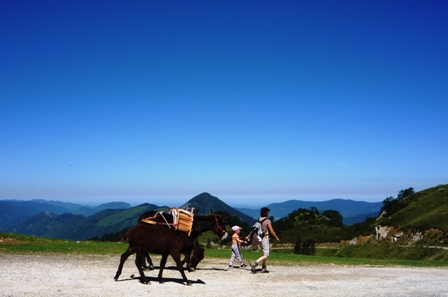
Le Parc Naturel des Pyrénées (or the Pyrenees holiday park!)

When you have a house in southern France, it tends to fill up in the summers and most holidays with lots of friends and relatives, which is why we are always grateful that we live in the entertainment park that is the Pyrénées. Here our guests, whatever their ages or inclinations, are spoiled for choice when it comes to deciding how to spend their days.

Our guests this summer have ranged in ages from babies to septuagenarians and all have been persuaded to venture into the mountains either for some serious walking or biking or simply to picnic or splash around in the mountain rivers. For little ones who can’t walk too far, there is the option to borrow a donkey for a few hours to take the strain- or even just the picnic – and for those looking for adventure, there is the chance to try their hand at kayaking or canyoning or to hike right over the Pyrénées and into Spain either on foot or on horseback.

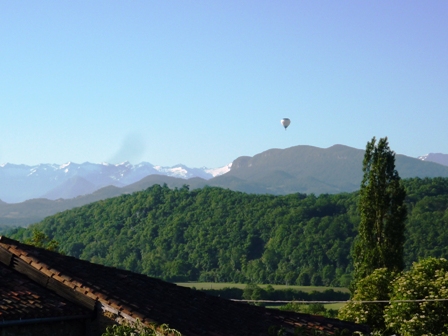
At Superbagnères, the ski resort above Bagnères de Luchon, the telecabine opens in July and August, fitted with special carriers so you can take your bike up to the top of the mountain and then cycle around the trails at the top before making your way back down. Bikes and push scooters are available to hire as is almost any type of mountain equipment you can think of or you can just take the lift to the top to admire the scenery. And on most sunny mornings in summer we open our shutters to the sight of the local hot air balloon taking visitors up and down the valleys for a wonderful bird’s eye view of the Pyrénées.

If all that sounds far too active, there is nothing nicer than sitting on one of the café terraces dotted around the towns and villages here and admiring the mountains from afar whilst enjoying the benefit of the wonderful produce that the region provides in abundance.

If we didn’t live here, this is certainly where we would choose to spend our holidays!

Gold or french property?

During a search, it usually takes me around eight weeks to draw up a short-list of perfect properties for my clients. That usually means I will have visited around 80 to 100 properties, most of which I will have eliminated as not matching all the important criteria. The short-list builds up slowly until there are about eight to ten properties by the time my clients come out to view them with me.

Sometimes however, people are happy for me to take a bit longer with the search, particularly over the summer months when they don’t really want to come out to look at properties in the height of the holidays when accommodation is often booked up and the cafe and restaurant terraces are crowded. Plus many estate agents close down for two or three weeks in August anyway so as to avoid what they call ‘property tourism’ which involves bored tourists deciding to get a free tour of the area with the local estate agent even though they have absolutely no intention of buying anything.

Usually a longer search is no problem – houses don’t generally sell that quickly in France and many of the places I find are new to the market anyway or sometimes have yet to actually reach the open market. However there has been a bit of a shift lately and a slightly surprising one considering all the doom and gloom surrounding the property market in many parts of the world. Here there are certain price brackets where property seems to sell almost as soon as it reaches the market. Whether this is just here in the Midi-Pyrenees or all over France, I don’t know but here, the last few searches I have done between the 150-200,000 Euro price range and above 500,000 price range, I have seen houses new to the market, actually sell in the few weeks between making it to the short-list and my client’s viewing trip.

I am no economist and can only hazard a guess at why this is; so here is my theory. Within the 150-200,000 Euro price bracket, there is a great deal of buyer competition and not a huge number of properties available. This is the bracket in which many of the French find themselves as well as many foreigners looking for holiday properties so it is just simply a case of too many buyers after too few houses and hence, the minute a good one comes onto the market and it is priced correctly, it will sell. The second category; property above 500,000 Euros, is perhaps harder to explain in the current economic climate but my guess would be that there are people all over the world who do still have money and are looking for somewhere safe to invest it. Gold is now looking like a bubble, the dollar and the Euro are both basket cases, the Swiss Franc is on a run and many property markets have collapsed. French stone property however still looks like very good value – prices have stayed relatively steady, the government and the economy of France are also more stable than most – and, in the very worst case scenario, if everything else collapses around you, you still have a very nice, comfortable, well-built and usually rather lovely house to live in and escape the troubles of the world.

Certainly if I had money to spend, I know where I would be putting it and it wouldn’t be gold bars – nor would I hang around too long!


All quiet here in the foothills

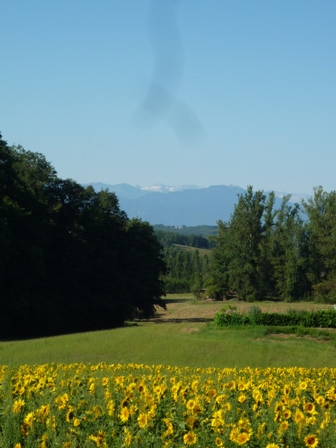
Scenes of sunflowers and mountains instead of rioting here in the Haute Garonne


My French friends and neighbours have been, if anything more shocked than us to see the images on the news of the English rioting, looting and setting cars and shops alight. This just does not fit the stereotype of the British that the French have in their heads in which we are still a quaint and proper, slightly uptight and certainly a non-demonstrative people. They expect such uncontrolled behaviour of the hot-headed Greeks, the fiery Spanish or even the Parisians (Paris is considered another country by people in this region) but they really never imagined seeing such images beamed out of Grande Bretagne.

We are lucky to be very distant from such troubles here; the nearest thing we get to a riot is when one of the old ladies queuing at the market gets served out of turn. Politeness is still king in this part of the world (drivers being the exception) and even chivalry still has its place, as I discovered yesterday.

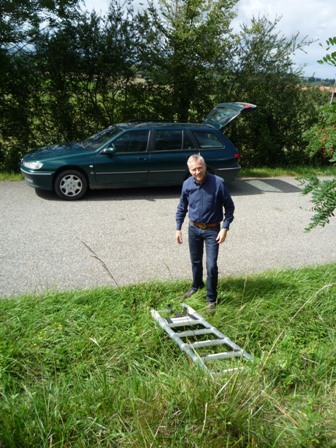
I was viewing some properties and building plots with one of the best agents in this region. True that flip flops may not have been the best choice of footwear for plodding around the hills looking at terrain and luckily I was holding the camera when I spectacularly failed to make the jump over a ditch and up the hill with embarrassing results (what I do for my clients!) So when I did finally manage to clamber up the hillside to the relevant plot, it was with huge relief that my now favourite agent provided the solution to my dilemma of climbing back down again, below:

I think it is safe to say that here are certainly worse places to be right now than the sunny South West of France!