View from the Foothills of France

Some personal views on living, working,
bringing up family and making the dream happen in the most beautiful region of France. View from the Foothills of France also includes some personal and professional thoughts and tips on finding and buying the perfect property in the Ariège and Haute Garonne regions.

Archives

Categories

Organic Ariège wine; delicious and healthy – santé

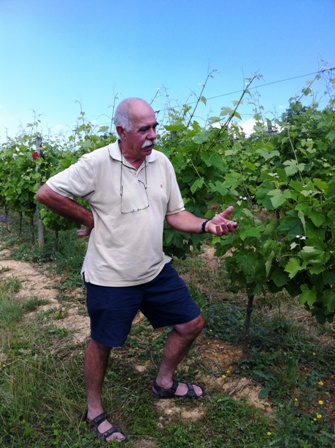
Philippe Babin, renowned organic winemaker of the Ariège

Most people have never heard of the Ariège – and that includes most French people – which means that very few people have ever tasted an Ariège wine despite the fact that the region now occupies the top spot for organic winegrowers in France, making up 25% of the total. However, the wines of the Ariège still tend to be ignored because the number of vineyards is minimal and the production is very low so it is actually very hard to get your hands on a bottle of wine from the Ariège. At the end of the 19th century, there were 20,000 hectares of vines in the region but thanks initially to industrialisation and depopulation followed by Phyloxia and World War 1, the vines were gradually abandoned until by 1979, there were just 2000 hectares of vines under cultivation and today there are fewer than 100 winemakers in the region.

We were recently lucky enough to meet the charming Philippe Babin, one of the best-known organic wine producers in France, who produces the delicious Côteaux d’Engraviès. His vineyard is situated in little village of Vira to the east of Foix in a beautiful pocket of rolling hills tucked below the higher peaks of the Pyrenees. He started growing vines in 1998 on land which had never been treated with chemicals and thus was able to secure a subsidy to grow and produce organic wine. He took us on a fascinating tour of his vineyards and is an eloquent and entertaining host, clearly with huge passion for his wine and immense knowledge which he is happy to share. He insists that it is perfectly feasible to produce delicious wine organically and argues that it is only by growing without chemicals, that it is possible to get the true flavour of the grapes and the ‘terroir’; that all important hidden ingredient in every wine – the flavour provided by the land and position on which the grapes are grown. He also points out that the Ariège is a magical area for wine because it sits on the climatic cusp between the Mediterranean and Atlantic with influences from both, as well as from the mountains and thus he is able to use both traditionally Mediterranean grape varieties and traditionally colder climate varieties from the Atlantic region to create a truly special and unusual wine.

Philippe makes just three wines and I can confirm (after some serious tasting both in situ and since) that they are all delicious. If you are lucky, you might be able to buy his wine from his website but it is very much first come, first served because demand for Côteaux d’Engravies now outstrips supply. Even better, pay him a visit. Here’s the website: https://www.coteauxdengravies.com
The reality behind the photos

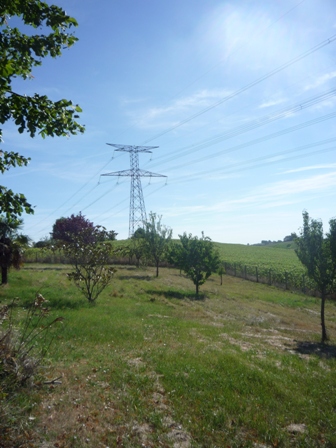
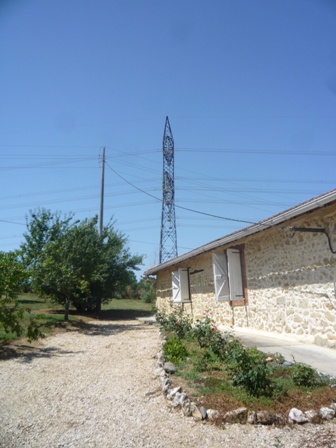
I thought this photo perfectly illustrated one of the many reasons why it pays to use a property finder out here, especially if you don’t have the time or money to make endless trips to France to view properties which look perfect in the photos but then turn out to be very disappointing in reality.

Of course, I am sure that there are plenty of people who wouldn’t mind living under a high voltage power line – I have even seen new houses built right underneath so that you can hear the hum of the electricity passing overhead. Others may be happy to have a huge pylon as a feature in the middle of their garden. But I know from experience that the majority of people moving to France are looking for a better quality of life and a healthier lifestyle and there is no way that I would ever recommend a house in this particular type of ‘hot-spot’ for any of my clients.

Hence the 90 minute round trip to view this property was a complete waste of time. But at least it was my time, not my clients’ and this is, after all, my job. Although these wasted viewings are very frustrating they are a large part of the search; the process of sorting the wheat from the chaff and making sure that I have seen every apparently suitable house for sale before drawing up a short-list of the very best properties on the market that match budget and brief. It is a time-consuming and frustrating process but also immensely satisfying when I know that I have found the ‘one’.

How much is a French property really worth?

I am sure I am not the only one drawn to Estate Agent’s windows whenever I visit a new country or region; of course houses are my business so perhaps I have more interest than most but I think many of us are fascinated to see the different sorts of property for sale in other places and the prices that are being asked. This is of course why estate agents put their most photogenic and seemingly best value properties in their windows – a sort of juicy worm to hook people in. But I know by experience how very misleading such properties and prices can be – it is the same on the internet with beautiful shots of tightly cropped and apparently very cheap houses for sale giving the impression that property in France is as cheap as chips. Well property in this region is certainly very good value but I think that many people window shopping for houses this summer are likely to be disappointed if they are thinking that they will be able to pick up something for almost nothing and, if it looks too good to be true, more often than not, it will be.

Although it has now become a buyer’s market in France, there is as yet no general agreement that the reduction in the level of sales will be accompanied by any major collapse in prices and the general strength of the market over the past two years has surprised many analysts.

The difficulty for buyers in France right now is of course is how much a property is really worth and how much they should offer? It is usually said that a property is worth whatever someone is prepared to pay for it but it is human nature to want to get the best possible deal. The difficulty is working out what the best possible deal actually is and what the ‘right price’ should be? Is a house in the middle of nowhere worth more than a house in the middle of a village or vice versa? And is it better to buy a rundown property and spend money on improving it or buy one at a higher price where someone else has done the work? Is an old house worth more than a new? How much value does access to big towns and good transport links add to a house? And, in this region particularly, how much more does a view of the mountains add to the price of a property?

Although I have a good feel for what price a house should be in my region, I do still always look at four basic things when calculating if the house is correctly priced and deciding at what level to start the negotiations for my clients:

Firstly it makes sense to get an idea of what other similar properties are for sale in the vicinity and at what price. If the property is far more expensive than anything similar in the area then it has probably been priced at that level by the owners who think that is what it is worth rather than an estate agent or Notaire who will have a better idea of the real value. You need to be particularly wary of private sales for this reason and do your research well.

Secondly it helps to find out how long the property has been on the market as this will allow you to judge whether or not a lower offer seems plausible. A low offer on a property that’s only been on the market a few weeks is less likely to be accepted than an offer on a property that has been on the market for a year.

Thirdly it is very useful to find out whether there have been any price reductions. If a property has been recently reduced in price then it is unlikely that the owners will drop the price a lot further. Again, do your homework and find out if offers have been made in the past and, if so, what level were they at if you can – although this information can of course be difficult to get hold of.

Fourthly, it is always useful, if at all possible, to find out the personal circumstances of the seller and whether there is any urgency to sell. To find out the truth however is not always easy and usually takes a great deal of detective work.

A lot of people think that the current economic crisis in Europe means that French property prices are free falling. This just isn’t true. Whilst there are fewer properties being sold, there are also fewer properties for sale and prices are remaining stable. So by all means make an offer but be realistic or you are likely to be disappointed and tread carefully before making a lowball offer; the French tend not to take kindly to low offers and can feel insulted, meaning that chances of further negotiation are slim.

Dare I say that, of course, the very best way of ensuring that you are only paying what a property is worth and not a penny more is of course to employ a property finder…

Oh and a final word on all the scaremongering in the press about increased taxes on second home owners in France. For a start these are all still proposals but should they become law, they will have little or no effect on the vast majority. First rental tax only applies if you let your house commercially and the majority of second home owners don’t – they simply accept contributions from guests. Secondly UK tax payers are already liable to UK CGT on foreign property and tax paid in France is in any case off-settable against any UK liability and that will remain the case.

Up and Over to Barcelona

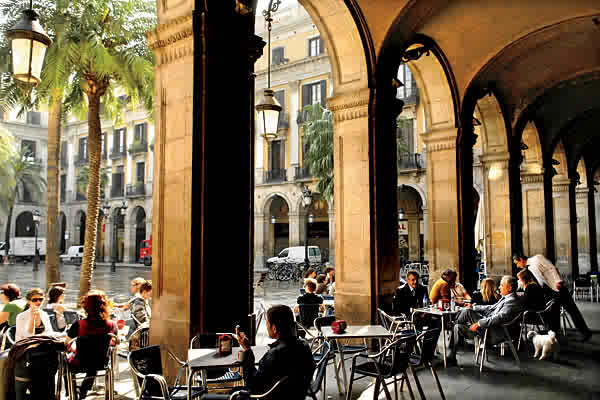
The longer we live in this privileged location, the more I realize how lucky we are to be in reach of so much.  Both the Atlantic and the Mediterranean coasts are an easy daytrip; skiing at a choice of resorts is just an hour away; fabulous walking, cycling, kayaking and just about every sport is on the doorstep; we are also just an hour away from the lovely city of Toulouse and, for a weekend of a very different city culture, Barcelona is just a 3 ¾ hour drive, up and over the mountains from us.

Hence we have just come back from a perfect weekend in one of my favourite cities where it is equally possible to visit fantastic museums and exhibitions, eat some of the best food and drink some of the best wine in the world and spend time on the beach or just wandering the maze of historic streets and enjoying the very Spanish architecture.

We left home on Friday afternoon and set off over the mountains for what must be one of the most stunning cross-border drives, winding up the green French valleys and over the Pyrenees down into the plains of Spain. Just four hours after leaving, we were enjoying a chilled cava and seafood tapas watching the sun go down over the yachts, illuminating the city and hills behind. Barcelona really comes alive in the evenings and at weekends and you can’t help to relax and enjoy the party mood. People were incredibly friendly, service excellent and, of course, the weather was perfect, the cooling breezes from the sea keeping the temperature at a very comfortable level. We saw lots, visited lots, walked lots, talked lots and ate and drank lots; perfect.

The drive home was equally stunning; it is always a great feeling to leave the baked Spanish plains and come back over the mountains back to our unspoiled and very beautiful little corner of France, having had our fill of Catalan culture, a country so close and yet so different. After just two days away, we arrived home feeling as if we had been on holiday and hugely appreciative yet again that we discovered this very special location with so much so close.