View from the Foothills of France Some personal views on living, working,
bringing up family and making the dream happen in the most beautiful region of France. View from the Foothills of France also includes some personal and professional thoughts and tips on finding and buying the perfect property in the Ariège and Haute Garonne regions.
|
By nadia, on 18th April 2013
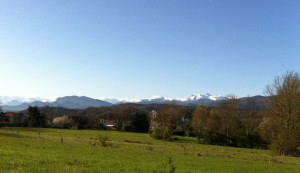
 Spring in the Pyrenees For most people, buying a house is not something they do regularly and it is easy to miss important details or forget to ask the right questions in the excitement, emotion and stress of the moment. So here are some things I look for and questions I ask when viewing properties or deciding on the right offer to make for clients:
- I always ask the seller why they are selling – not that you will always get the real answer but many are sellers are surprisingly honest!
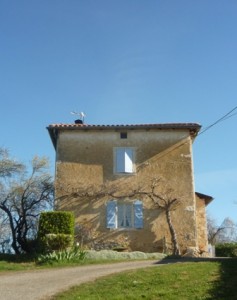
- Look up and check the roof, are there any missing tiles or slates? Does it look in good condition or is it starting to sag? Does the guttering leak or can you see any gaps? The French are generally excellent at maintaining their roofs but a new roof can be a big and expensive job so, if it does need re-doing, it is worth being aware of this fact so that it can be used in negotiations.
- Check that the windows are in good order; whether there is any flaking timber or glass which is misting up if double glazed?
- Turn on taps and showers; is there good water pressure? Does hot water come through quickly? Are there any leaks?
- Do you have mobile phone reception? Can you get the other communications you need, such as satellite or cable TV and broadband?
- Do rooms catch the sun, or need extra light? Can you see condensation on the windows?
- Can you hear people around the house? Try walking upstairs and in a room when one of you stays below, is it really noisy?
- Make sure to take a look in the attic and especially at the beams to check for live beetle. The attic is also a good place to check if there is any insulation and in what state.
- Check what is included in the sale; often the French will expect to take everything when they go including light fittings and most of the kitchen so it is worth being sure on this point.
- Is the house private or overlooked by neighbours and, if overlooked, is there a way of securing privacy? If there are neighbours, I always take a sneaky peak into their garden to see what sort of state it is in and whether they have animals such as geese which can be smelly and also very noisy.
- I also ask whether surrounding fields are ‘constructible’ or whether the land is ‘agricole’ because, if constructible, you are likely to have new houses appearing next door.
- Check for damp – can you see or smell any? This can be dealt with but it is worth knowing about in advance and before moving in.
- Does the property have the space you need? If not, in theory, is there room to extend the property, either into the attic or into an adjoining barn and would it be possible to add an extra room or two to the house? For example, if the house is in the Parc National de l’Ariège or in a ‘Batiments de France’ area, any additional building is unlikely to get permission.
- Which way does the property face? South and east facing are the ideal but in this region, which gets very hot in summer, it is also important to make sure that you can use the north side or at least have a shady terrace in the summer months.
- Is there a fosse septique (septic tank) and, if so, is it aux normes (the requirements for septic tanks have recently changed in France and the majority of properties will need a new one or some work done to bring it in line with regulations.) Budget 3-5000 Euros for this.
- How is the house heated? This is becoming an ever more important question with the high price of gas and oil. I am increasingly looking for houses where some of the energy is provided by alternative means such as wood, solar or geo-thermal.
- How much are the Taxes Foncieres and Taxe d’Habitation – these are the property taxes and generally are much lower in France than in the UK and many other countries.
- If the house is near a road, how busy is it? I usually go back to a property on several occasions at different times of day to check on this if it might be an issue although, in this part of the world, the most usual noises are generally cow bells or logs being cut. I have, however, viewed a house which was in a lovely peaceful spot with only one close neighbour but I noticed that, hidden behind this neighbouring house, were what look liked kennels, albeit empty and sure enough, when I returned the following week, in the evening this time, the howling of hunting dogs from next door was unbearable.
- How close are the nearest shops? In France it is also worth asking whether there is a baker’s van or butcher’s van that passes through because most hamlets are served by these at least once a week and often three or four times a week.
- In the South West of France, it is also vital to find out if the road to the property is cleared of snow by the town or village services in the winter. If the property is in a hamlet and has village electricity and water and families living there, they almost certainly will be on the ‘deneigement’ route but I have found houses or barns in the mountains that are hidden up tracks which are definitely not cleared of snow automatically and so you run the risk of being cut off for the odd week in the winter which many people here do not mind but it is worth being aware that this might be a possibility before it actually happens.
- Most buyers tend not to have surveys in France but, if the house needs work, I often ask a builder to take a look at the general state of the house to ensure that there are not likely to be any nasty surprises after the sale.
- Finally I always have my camera and my notebook on every viewing as the camera often sees details that the eye misses at the time and I write copious notes to jog my memory about every detail or issue that I want to check further.
Viewing houses can be really enjoyable and exciting or equally can be (and often is ) very disappointing but, if you feel that you have seen the house for you, just take a bit of time to ensure that you know exactly what you are taking on and that you will be able to deal with it. A house is for life, not just for a sunny day after a glass or two of rosé at lunchtime. My main aim is to ensure that my clients get the best possible house at the best possible price and have thought through all the pros and cons and this should go for everyone thinking of buying a house in France.
By nadia, on 27th March 2013 
Nothing illustrates more clearly the rise and fall of foreign home ownership in France than the currency exchange transactions and mortgage applications from foreigners looking to buy a home a France. And, although the property market in France has slowed during the economic crisis, France is still the top foreign buyer’s property hotspot according to all of the main financial organizations.
For example, HIFEX, the currency exchange specialist has recently published its Property Hotspots Report which puts France at the top of the list of overseas markets with 23% of potential buyers looking for a property to purchase in France with many believing that now is a good time to pick up a bargain.
The report, which reveals the top destinations for property ownership abroad, showed that buyers remain undeterred by the economic uncertainty in the Euro-zone. It also revealed that they have not been discouraged from buying property in France by the tax hikes that were introduced by the French government following the election of President Hollande. “With an abundance of low-cost airline routes, more tourists than any other country in the world, easy access and the great choice France offers for both snow and sun lovers, it’s easy to see why France remains a favourite with British buyers and regularly tops quality of life polls,” comments HIFEX director Mark Bodega. “In troubled times owners and investors seek safe havens, and they simply don’t come more secure or enjoyable than France.”
The Overseas Guides Company (OGC) saw an increase of over 40% in overseas property enquiries in 2012 with France continuing to be the most popular destination. France firmly secured its position as the UK’s favourite place to purchase a home overseas, attracting the largest share of enquiries for each quarter last year, according to the data provided by OGC. The country ended the year strongly by recording a higher level of interest during October, November and December – traditionally a quieter period – than in both the first and second quarters of 2012.
Richard Way, editor of OGC commented: “Interest in France surged in the summer months and then never really fizzled out….Prices are deflated in most popular European destinations, but France appears particularly good value for money at the moment, given the numerous pretty character homes available there for very attractive prices. Village homes are particularly affordable and sought after.”
Research by overseas mortgage specialist, Conti, shows that the stable nature of the French property market and a good quality of life are the main reasons why buyers are attracted to French property. Clare Nessling of Conti comments: “Buyers have increasingly been sticking to locations they know and trust.”
Most Francophiles know only too well that France offers all sorts of lifestyle advantages but it is reassuring to know that the financial experts also believe that France is a good bet.
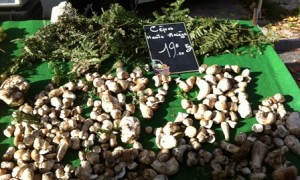
By nadia, on 5th March 2013  Pick ‘n’ mix – cepes, the king of the mushroom
The whole horse-meat farce has highlighted once again a subject close to my heart – the importance of buying and eating locally sourced, fresh and seasonal produce. In many countries we have become far too far removed from the source of our food and far too disinterested in how this food is produced. Thank goodness this is not the case here in the Ariège (one of the many reasons we are here) where there is a very strong tradition of producing one’s own food (fruit, vegetables, eggs, rabbits and pigs) and of buying from local producers so that you know exactly where your food is coming from and what it contains (or hopefully doesn’t contain).
This is the right part of the world for me because I actually have a pathological hatred of shopping (in shops) which I realize is not very girlie of me but it is just not my thing. Luckily nowadays when I need a new shirt or pair of jeans, I can simply find and buy online and have my friendly postie deliver without having to go near a shop. And I particularly dislike shopping in the supermarket but this is something I find much harder to avoid because we are a family of six on a budget. In France, supermarkets are just beginning to cotton on to the idea of grocery shopping online but it is too big and too rural a country for home delivery to be an option so I do find myself in Intermarché far more often than I would like.
Having said that, however, one of the many reasons I love living here in South West France is that it is still quite possible to do the majority of the weekly shop at the local market which is exactly what I do. So every Monday morning, as soon as I have dropped the children at school, you will find me in the market place at Salies du Salat where I am first name terms with many of the stall holders and where I can find wonderful local, organically grown, in-season produce at a much better price than in the supermarket. Here shopping is brought back to a human level – I can discuss every subject under the sun (the French just love a good debate) while choosing my apples or my ham and generally pass the time of day so that by the time I am finished it just feels that I have spent a pleasant couple of hours chatting having incidentally done my weekly shop. We are spoiled for choice for fantastic local produce here; the cheese is out of this world, the eggs freshly laid, the meat excellent quality (yes there is horse but it is labelled as such!) and locally sourced and the fruit and vegetables are seasonal unless they have come over the border from Spain, in which case it is possible to find the odd red pepper or tomato in the winter months. Then a quick trip to the smiliest bakery in France and I am back at my desk by mid-morning to begin my working week.
By Saturday, if we are running out of fresh produce, we have one of the best markets in France, incredibly colourful and eccentric, just 15 minutes away in Saint Girons which is worth a visit even if you don’t have any shopping to do.
Somehow shopping at the local market is uplifting and life affirming while supermarket shopping destroys the soul. I leave the market feeling happy and energetic and I leave the supermarket feeling depressed and drained. If only I could wean my children off breakfast cereal and pasta and myself off coffee and chocolate, I could pretty much eliminate the supermarket shop altogether which I think is going to be one of my new season resolutions.
And now I shall get off my soap box and I promise my next post will be back on property…!
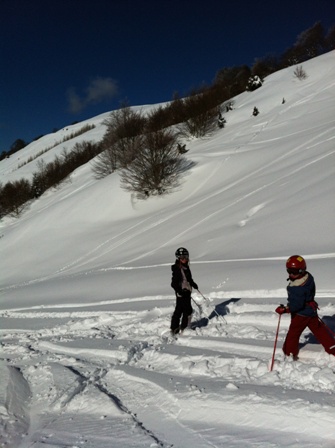
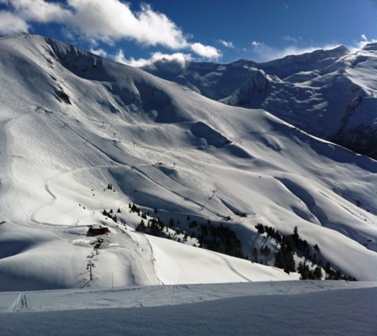
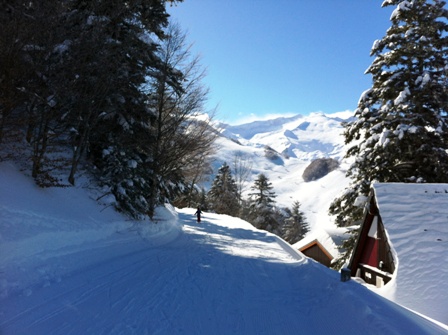
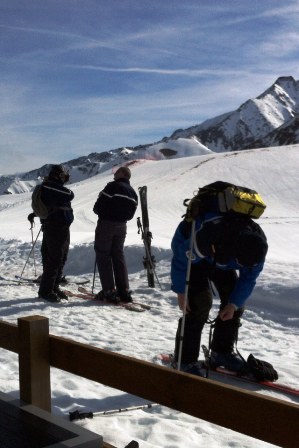
By nadia, on 13th February 2013  A tough day at school! We have discovered since living in France that, most of the time here, it is best just to go with the flow. Hence, when we learned on Monday that Tuesday school was cancelled (teachers on strike for the day), rather than stressing about childcare and cancelled meetings, we decided to ‘saisir le jour’ and hit the slopes for the day, despite the forecast looking decidedly ropey. The teachers, however, clearly had insider knowledge that neither we, nor Meteo France were privy to because by the time we had our skis on, the clouds had cleared, the sky was blue, the views were breathtaking and we spent the day skiing on 30 centimetres of fresh powder and almost empty pistes (only a few teachers to be seen here and there!) in the sunshine, punctuated by lunch in our favourite restaurant.
 Nice spot for lunch – Chalet Beauregarde It is days like these which remind us why we decided to settle in this very special part of the world. There can’t be many places where you can be skiing within an hour of leaving home and the fact that our nearest skiing happens to be one of the best kept secret in the Pyrénées, means that we often feel as if we have our own private ski resort. And yet, while much of Europe has been struggling with bad weather and snow, we have not had any at home; we just have the pleasure of looking at it on the mountains from the window and enjoying it on sunny days when we feel like it.
Empty pistes and fresh powder snow The teachers certainly picked their day for a strike – and we are already looking forward to the next one!
 Paradise in the Pyrenees
P.S. We weren’t the only one bunking off – the gendarmes were at it too!
 Police on the piste
|
For further information please contact us:
|



You must be logged in to post a comment.