View from the Foothills of France Some personal views on living, working,
bringing up family and making the dream happen in the most beautiful region of France. View from the Foothills of France also includes some personal and professional thoughts and tips on finding and buying the perfect property in the Ariège and Haute Garonne regions.
|
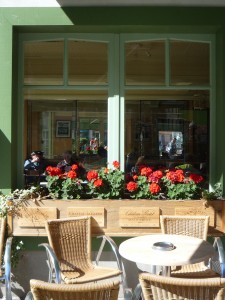
By nadia, on 15th October 2013  CAFE FRANCAIS ASPET All the talk in the British press (as well as in the Australian and American press) over rising house prices, gazumping, gazundering and property bubbles makes me (yet again) very glad to be living in France where people are rather more rational about houses and the property market is hugely more stable and reliable.
I would not like to run a property finding business in a country where you can still lose the house of your dreams five minutes before exchange or even completion. I remember all that stress with horror and I am so glad that my clients do not have to go through that here. The French property buying system is much more regulated and straight forward and far less stressful for both buyers and sellers.
Here’s how it works in France: Once you have seen your perfect house, the first stage is to make an offer. I usually do this verbally while carrying on negotiations and, as soon as a price has been agreed, I put the offer in writing and the vendor signs an offer acceptance. At this point, a Notaire is appointed who usually represents both seller and buyer (this avoids all the complication and time-wasting involved when two legal bods have to communicate with each other) and the initial but binding contract, the Compromis de Vente is drawn up. This usually takes around 10 days to two weeks for this to be ready for both parties to sign (although it is sometimes possible to sign almost immediately) and both parties submit a deposit of 5-10% to the Notaire. As soon as the seller signs, they are legally bound to sell or forfeit their deposit. The buyer has another seven days after signing, known as the ‘cooling off’ period when they can still pull out but, after this, they are also bound to proceed with the sale or lose their deposit.
Once the Compromis de Vente is signed, in most circumstances, the house is yours. The only reason why the sale should fall through from this point would be if there was a ‘Clause Suspensive’ in the Compromis allowing an ‘opt-out’ if , for example, the buyer fails to get a mortgage. Otherwise, from this stage, which is usually about three to four weeks after the offer is accepted, both buyer and seller can relax and start making plans for moving house at an agreed completion date (where the Acte de Vente is signed) which is normally around three months from the signing of the Compromis. There is none of the stress that somebody might come along with a better offer and you will lose the house nor that the buyer will suddenly decide that they want to pay less than agreed and reduce their offer price – this just cannot happen.
To me the French system makes so much sense and works so well that I cannot understand why in the UK and other parts of the world, countries still hang onto a stressful and complicated process of selling and buying houses which, moreover, seems to bring out the worst in everyone.
Of course you can never eliminate all of the stress involved in finding and buying a property but at least here in France, it is a safe, regulated and usually an exciting and enjoyable experience which, more often than not, ends with a shared glass of champagne and the first of many new friendships.
By nadia, on 2nd October 2013 
I always tell people that one of the things that worried me most when we decided to move lock stock and barrel to France was our children and how the move would affect their lives. As it turned out, it was the best thing we could have done for them, providing them with a much better quality of life, huge amounts of freedom and broadened horizons as well as, of course, a second language. We also discovered that children are incredibly adaptable, quick to learn and in fact settled in much more easily than we did.
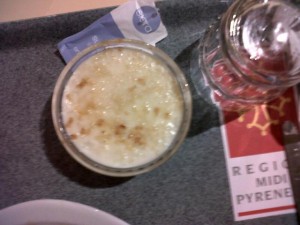
The contrasts between our lives here and the life they would have had in the UK are huge but none is more obvious than the quality of the food and the culture of eating. This has been well and truly brought home to me in the last month with our youngest daughter starting secondary school or college as it is here. While I have spent her first few weeks worrying about the early starts, the school bus, the long days and the homework, my daughter clearly has different preoccupations. Every day, she has been taking photographs of her delicious school lunches for me to enjoy while I chomp on my apple between viewings! And I am jealous; see above – starter, main course, salad, cheese and pudding and this is just one meal on one day; I wouldn’t be at all surprised to spot a carafe of wine somewhere in the photo.
I couldn’t be happier about this; it is one of my great soapbox subjects, the lack of interest in or education about food and nutrition in UK schools, the constant debate about increasing obesity and the fact that the obvious link is just not being made when it is so clearly the result of a generation of children who have been brought up with no education and hence knowledge of how to feed themselves well. This generation now has children of its own and has no cooking or nutrition skills to hand on and hence we are stuck in a downward spiral.
Thank goodness, the same cannot be said in France; at our primary school I am always amused that at every school meeting, most of the discussion focuses around the lunch menus and I am delighted that, at my daughter’s new school, there is a great emphasis on using local, seasonal and organic produce and serving this in balanced and delicious meals. Moreover, at home, children see their parents cooking fresh meals every day and it is the norm for every family sits down to eat together at least once a day if not twice (50% of the children at our primary school go home for lunch.)
I know this has nothing to do with property but to me it has everything to do with living in France and understanding the French culture and underlines yet again why we are here.
By nadia, on 5th September 2013 
As it is ‘La Rentrée’ (back to school time) and traditionally a very busy period for house hunters, I thought it might be a good moment to take a look at the property market here so far this year. For me personally, the year got off to a slower start than usual but then took off in February culminating in my busiest two months ever in July and August. Talking to the agents here confirms a similar picture and certainly July was very busy for everyone across the board although August quieter for many agents as is usually the case.
So far this year house prices and property transactions initially stabilised and they now appear to be on the increase in the Midi-Pyrénées region. This could be down to French mortgage rates which are at an all time low or because, thanks to the financial crisis, there are some stunning houses on the market right now, many for sale at less than their true market value and hence investors are moving in. If you have been waiting for the best time to buy a property in France, I would suggest that this might be it. Belts are being tightened here as everywhere but quality of life remains high. What’s more, the Midi-Pyrénées region has an unusually high stock of beautiful and solidly built stone houses in lovely locations and this, combined with record low mortgage rates (the lowest for 65 years and the best in Europe), means that it is a buyer’s market here right now.
Hence it is no surprise that I am getting lots of interest from investors looking to lock in some long-term capital in consistently high value and stable French bricks and mortar. However, I would still suggest that your reasons for moving to this region should not just be financial; when you choose this region, you are buying a way and quality of life, not just a property investment and a ‘good buy’ means more than just getting a bargain.
How the rest of the year will pan out is yet to be seen but, by the number of enquiries I am getting, it certainly looks as if the Ariège, Haute Garonne and Southern Gers are the places to be right now.
By nadia, on 26th July 2013
Before moving to France, I didn’t do much cycling: in fact I didn’t even have a bike. This wasn’t just because of the weather (although cycling is never that appealing in the rain) but because I am not really into adrenaline sports and getting on a bike in the UK always seemed a dangerous rather than relaxing pastime. I think it is something to do with the mentality of many British drivers and the fact that it appears to be ingrained in drivers in the UK to see cyclists as pests; hence cars pass far too close, hoot if they think you are in their way and generally seem to resent sharing the road space. Fantastic as it is that we now have the positive cycling role models of Wiggins, Froome and Hoy who have certainly hugely increased the popularity of cycling in the UK, it certainly doesn’t seem to have made the roads any safer and I never feel that England is a fun place to ride a bike.
The problem is that there is no real cycling tradition in the UK, unlike in Holland, Italy and, of course, France. In these countries push-bikes are an integral part of the culture, and drivers have an in-built respect for cyclists. No wonder Britain’s best professional cyclists base themselves abroad, where they are assured of a warmer climate, better road conditions and a positive attitude to cycling.
In France, there is not only respect for cyclists but a real cycling culture so that you will see both lycra-glad super humans ascending apparently vertical mountains but also old ladies on pre-war bikes with a baguette under one arm and a basket of vegetables balanced precariously on their handlebars. And both sorts of cyclists are given equal deference and distance by motorists and will also greet each other politely with a cheery bonjour as they pass; you don’t have to be an Olympic medal hopeful to be given respect on the roads here.
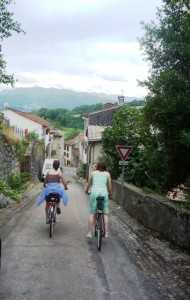
Perhaps it is also to do with the slower way of life but cycling in France is more relaxing and a great way to spend some time en famille. There is much more space, open countryside and pretty villages to explore, as well as course as numerous bakeries and cafés to sample en route. And you can guarantee that anywhere you arrive en vélo, you will get a warm welcome. The French are generally interested in bikes too; my first trip on a bike to France was on a tandem with my future husband (yes we still got married!) We borrowed the tandem from friends and took the ferry to France and cycled to Honfleur and then Pont L’Eveque. Now riding a tandem is something else again and we were so wobbly we could only stay upright by emptying the panniers of everything save our toothbrushes but we improved as the days went on and everywhere we stopped, a crowd gathered to admire the bike and chat; somehow a rosbif on wheels is deemed more acceptable.
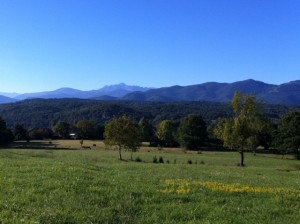
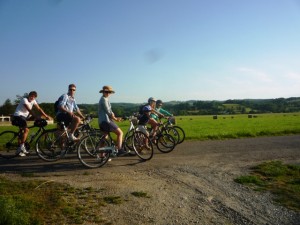
Now we live in an area perfect for cycling; we have the back drop of the Pyrénées yet live in a wide open valley where we can cycle for miles along the river and on quiet, back lanes with hardly any cars. And when a car does pass here, they give you as much room as if they were overtaking another car and often hoot to warn you before they do so. Often they will wait ages behind us until the opportunity is right for overtaking which is extraordinary because the French can be terrible drivers, happy to overtake another car on a blind bend but somehow they react differently to cyclists, making this probably the safest way to get around here. The children have the bug too because a bike provides instant independence so they can go off to the tennis court or riding stables on their own or just to buy an ice-cream with their friends without having to rely on us. When it comes to cycling, I would say that France wins hands down (well apart from the Tour de France but the less said the better there as far as our neighbours are concerned!)

|
For further information please contact us:
|





You must be logged in to post a comment.