View from the Foothills of France Some personal views on living, working,
bringing up family and making the dream happen in the most beautiful region of France. View from the Foothills of France also includes some personal and professional thoughts and tips on finding and buying the perfect property in the Ariège and Haute Garonne regions.
|
By nadia, on 5th January 2016 
Whatever your job and your experience, if you are honest, do you really feel qualified to find and buy a French property without some expert (and unbiased) advice? Even if you speak good French, it is probably unlikely that you have a perfect understanding of how the French property market works. There is, of course, plenty of information out there on the internet but there is also plenty of misinformation and it is very difficult to differentiate the two.
Even if you have bought lots of properties in the past, the French property market is different to many property markets. On the internet, there is no Zoopla or equivalent multiple listing site of all of the properties for sale in a particular area in France and, in addition, most houses appear on a large number of different sites, often at different prices with different photos all of which can be very confusing. In addition, of course, these listings are there to sell the property, not to give you the true picture of what the house is really like.
There are certainly plenty of estate agents in France and they will be incredibly helpful and nice when you visit them in their offices but try seeing how many reply and keep you up to date with new properties when you are contacting them from abroad; it can be a very frustrating process according to most of my clients who have tried it before coming to me. Remember an agent is there to sell you a house on their books and they are really not interested which one or whether it truly matches your criteria. Most of these agents work on a commission only basis and so they just want to sell you a house and the more houses they show you, the more likely they think they are to sell you something. What’s more, they only have a limited number of properties to sell and those only in a small area so you will probably need to deal with numerous agents to ensure you get information about every property for sale in the area you are looking.
It is true that coming to France to view lots of properties can be fun to start with but those trips (there are likely to be many) will soon become a huge waste of time because most of those houses you have booked to see, will turn out to be totally unsuitable. If you have plenty of time and not much else to do, this probably doesn’t matter but, if you are short of time, there are probably better ways of spending it.
When time is precious and getting it right is important, why not ask a property finder to do all the research and leg-work for you? A property finder will already have a feel for what is on the market that matches your search criteria and budget. They will deal with all the agents in the area but also the notaires and private sellers and they will also be able to dig out houses that are not on the open market. Once they have done the initial research, they will pre-visit all of the houses which appear (on paper) to match your criteria and it will be their time wasted rather than yours when the majority of these properties do not in fact match up to their promises nor meet your requirements. When your property finder does finally view a house which seems to be a good fit, they will take photos of how it really is and write up a report for you so that gradually you will have a short-list of houses that really do match your criteria.
Hence, when you finally make that trip to view your short-list of box-ticking houses, you know already that it will not be a complete waste of everybody’s time. It will be a well organized and managed few days to maximize your time and show you everything that you have already pre-approved. Moreover, you know that, when you finally meet your property finder, he or she will be completely impartial and able to give advice on all aspects of buying property in France, living in France and will offer an in depth knowledge of their region. Plus, they will be completely on your side before, during and after the sale.
I wouldn’t buy a property abroad without using a property finder; I have too little time and, what I do have, is too precious to waste. If you have similar concerns, why not get in touch, it could well be the best investment you will ever make and certainly the best investment you make this year: nadia@foothillsoffrance.com
Wishing you all very happy and successful property hunting in 2016
By nadia, on 24th November 2015 
If you are thinking of buying a house in France, you are most likely caught up in dreams of pretty French houses, delicious food and wine and a slower pace of life. Probably the last thing on your mind is admin, paperwork and bureaucracy. If you are using a property finder, they will deal with most of the irritating and time wasting processes, research and bureaucracy of actually finding and buying the house but there are still some things you need to think about and preferably ahead of time to make your purchase and make your first few weeks in your new house as stress free as possible. In France, the way to beat the bureaucrats is to be prepared.
- Bank account – the first thing to have in place when you decide to buy a house in France is a french bank account. This is not a difficult process and has been greatly simplified for foreigners over the last ten years. There is even a French bank that now offers an English speaking helpline and most now have online facilities where you can easily transfer from your home country to France. Which bank you choose, will depend on your personal situation and the area of France in which you are looking but it is worth setting this up at the same time that you begin your property search.
- Currency transfer – it makes life much easier when you come to make an offer on a property if you have already organised a way of transferring your money from your home country and, ideally if you have already transferred some at an acceptable rate of exchange for you so that your spending power is not overly effected by fluctuations in currency. Make sure you use a reputable exchange company and usually a specialist will get you a better rate than your bank. I work with a currency exchange specialist to get my clients the best possible rate so contact me if you would like a recommendation.
- Visas – if you are not a European resident, you may need a visa and/or a carte de séjour depending on which country you are coming from and whether you are buying a permanent or holiday home. This can take time and lots of paperwork which will need to be translated and often the originals will be required. Never lose your patience with French officials however frustrating the system – you will never come out top of an argument with a French fonctionnaire. Stay patient, smile and ask for their help and expertise to get them on your side; you will get there in the end.
- Official Paperwork – the French love their paperwork; there is lots of it and if it is in duplicate so much the better. Make sure you can lay your hands on all your official documents such as birth, marriage and divorce certificates, driving licence, social security cards, insurance policies, utility bills etc. If you can provide a piece of official looking paper for every demand (preferably with a nice stamp on it), you will thrive in France.
- Insurance – the French also love insurance and you will need insurance for your house, car and health and also for your children if they are going to go to school in France. In France people generally stay with the same insurance company and most will use a local company and deal with them face-to-face – online providers have not really taken off yet in France; here people like to shake the hand of the people they deal with. So take the time to find the right company for your needs. In the past, you had to give three months written notice to cancel a policy and wait for the renewal date but recent changes to the law make it easier to change providers as you no longer need wait for contract renewal date to change over.
- Utilities – once you have a completion date for your French property, it is wise to inform the electricity and water providers that you will be moving in to ensure that you do not get cut off. On the day of completion, you need to read the meters and call the utility companies with the readings and to change the accounts into your name and address where you want your bills to be sent. They might want to see your ‘Compromis de Vente’ contract and you will also need a French bank account in order to get your utilities set up. If you are buying through an agent, they will usually change the utilities over into your name.
- Health cover – you will also need some form of health cover in France but this is very particular depending on which is your home country, whether you are buying a permanent home or a holiday home and whether you are retired or planning to work so you need to look into this depending on your personal circumstances. For anyone from one of the EEA countries and Switzerland buying a holiday home, you can apply for the EHIC card.
All of this may seem like a lot to think about but, if you deal with the necessary paperwork little by little or petit à petit as they say in France, you will find your French house purchase far easier and more enjoyable and your starting life in France a whole nicer experience.
By nadia, on 5th November 2015 ![3[22]](data:image/svg+xml,%3Csvg%20xmlns='http://www.w3.org/2000/svg'%20viewBox='0%200%20300%20200'%3E%3C/svg%3E)
Here in France, it is the time of year when French property taxes are due. If you own a property in France, then you will have one or two local property taxes to pay each year.
Taxe foncière is a land tax, and is paid by the owner of the property.
Taxe d’habitation is a residence tax. You have to pay this tax if you own a property and live in it yourself (or have it available for your use, or rent it out on short-term lets). Where properties are rented out long-term, the tenant pays.
Both taxes apply to non-residents as well as residents, and are often higher on second homes than on main residences due to possible discounts on the main home.
Demands for both taxes are sent annually, the bills or avis d’impôt start going out in September each year. The amount must be paid by a specified date, usually in October (Taxe foncière) and November (Taxe d’habitation) but varies from place to place. Failure to pay on time incurs a 10% penalty.
Payments can be made by cheque, interbank payments, bank transfers or online. There is more time to pay online, the deadline is usually extended a few weeks later than for the paper version.
Taxe foncière
Taxe foncière tax is paid by the owner of the property, irrespective of who occupies it. The tax is divided into two parts: tax on buildings (taxe foncière sur les propriétés bấties) and tax on land (taxe foncière sur les propriétés non bâties). The latter is no longer levied locally and is levied nationally instead. The tax on buildings is paid on any property that is habitable, whether or not it is occupied.
If you sell a property part-way through the year the tax is apportioned by the notary dealing with the sale.
An exemption is available against the main home if the occupant is 75 or over (or in receipt of certain disability or old age allowances) as at 1st January of the relevant year, based on the level of taxable income in the previous year. The calculation, which also applies to the exemption for taxe d’habitation, depends on the number of “family quotient” (quotient familial) units available.
For the 2015 taxe foncière, the maximum income levels based on 2014 income is €10 686 for the first family quotient unit (so this is the limit for a single person), and then €2,853 for all extra half units.
Where the taxpayer is aged between 65 and 75 at 1st January and their taxable income falls below the above limits, a flat €100 discount is available against the taxe foncière payable on their main home (unless they share the house with anyone other than a spouse or dependant).
Exemptions and reliefs are available on land used for certain purposes such as farming.
New buildings and renovated properties used as the main home are exempt from taxe foncière for the first two years after construction. Renovated properties can benefit provided that reconstruction or additional construction work has been carried out, and is determined according to the nature and size of the work. A special Tax Form (H1 or IL) must be filed with the local tax authorities within 90 days of completion of the property or renovation works.
With thanks to Sylvia Davis for this post: Editor, Property & Living, FrenchEntree
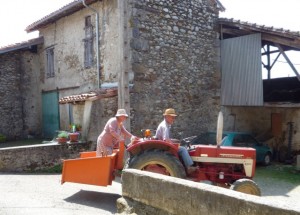
By nadia, on 20th October 2015  BlaBlaTractor – car sharing in the Ariège Traditional stereotypes of France are being turned on their heads: France is not the biggest producer of cheese in the world (that’s the US) nor does it boast the greatest number of varieties of cheese (that’s the UK). In fact, the latest ‘French Paradox’ has nothing to do with food or wine at all but economics where it has been used to describe the fact that, since the financial crisis, France has performed best where it was least expected to do so.
In a recent study comparing 28 international competitive rankings, France did best when it came to its dynamic companies, a strong capacity for innovation, and an impressive quality of research facilities – rather than just the good quality of life which is normally the reason it finishes high in league tables. The study noted that France finished second on the Forbes 2015 list of the top 100 most innovative companies, boasting eight companies overall – only beaten by the US.
In addition, in the 2014 Financial Times guide to the best MBA options in Europe, France performed second best overall, offering 19 top universities. It was only beaten by the UK, which had 20, and finished streets ahead of Germany in third place with six. Elsewhere, France finished fourth (out of 140 countries) when the World Economic Forum ranked the quality of its roads and internet connection. (With thanks to thelocal.fr for these figures.)
We’re told that France has been the sick man of Europe for as long as we can remember and many people have been predicting the downfall of the country at one stage or another in recent years but right now there is a different message coming out of the France. Last week, John Chambers, the boss of American tech giant Cisco Systems, took everyone by surprise when he said that France was the next “Silicon Valley”. He didn’t stop there. “France is the future; Germany and the United Kingdom, all these countries are following in France’s footsteps.” Here’s his interview (in French) https://bfmbusiness.bfmtv.com/entreprise/la-declaration-d-amour-du-president-de-cisco-a-la-france-920784.html?utm_campaign=Echobox&utm_medium=Social&utm_source=Twitter#link_time=1444300977
Chambers was talking about the digital revolution but he clearly believes that there are huge opportunities in France and he announced that Cisco was to double its planned €100 million investment in start-ups in France next year to €200million.
It is exactly France’s dynamic business start-up scene which has been one of the main reasons for France’s recent economic improvement since the recession. Admittedly most of these are based in and around Paris but it is home to 12,000 start-ups, which makes it top of Europe’s capital cities. Sentier, an area of the second arrondissement where many of the start ups are located has been nicknamed “Silicon Sentier”.
In addition, the French car-share service, BlaBlaCar has just become the first French start-up to be valued at over $1billion. The service is effectively a phone application that allows motorists and passengers to meet and share a car journey, saving both the driver and the passenger money. Founder Frédéric Mazzella pointed out that: “The French government is doing everything they can to help entrepreneurship. They are changing laws and the environment as fast as is humanly possible. They are doing super work. We want to make people understand that things are changing in France. We want people to talk positively abroad about France, there’s a change in spirit here.”
Mazzella is not the only member of the new wave of French business leaders preaching this line. “Clearly, something is happening in France,” Jérôme Lecat, head of Franco-American start up Scality told Europe1 radio. “We feel there is a new curiosity. Investors are coming to France at least, to see what is happening. One of them said to me recently, your teams are working like in Silicon Valley.”
Lecat and Mazella say that all talk of companies in France being held back by the inflexible labour market and strict employment laws are exaggerated and no longer accurate. Both say the 2008 reform that allowed “rupture conventional” or amicable partings between staff and companies was a major step forward, as was a 2013 law that allowed companies suffering from economic difficulties to temporarily reduce working hours and salaries. “I no longer have any problem with the French labour laws,” said Lecat.
Of course, France still has a long way to go to persuade business that this is a great country in which to invest. Unemployment is still at a record high as is public debt and France’s ever changing tax laws and red tape still put off foreign investors but, for once at least, the message is positive and a future France could be applauded not only for a better quality of life but also for a better quality of business.
|
For further information please contact us:
|

![3[22]](https://foothillsoffrance.com/wp-content/uploads/2015/11/322-300x200.jpg)


You must be logged in to post a comment.