View from the Foothills of France Some personal views on living, working,
bringing up family and making the dream happen in the most beautiful region of France. View from the Foothills of France also includes some personal and professional thoughts and tips on finding and buying the perfect property in the Ariège and Haute Garonne regions.
|
By nadia, on 11th February 2016 ![025[3]](data:image/svg+xml,%3Csvg%20xmlns='http://www.w3.org/2000/svg'%20viewBox='0%200%20300%20182'%3E%3C/svg%3E)
Britain joined the European Union in 1973 and, since then, hundreds of thousands of Britons have chosen not merely to holiday in Europe but to buy property or make our homes here. Higher disposable incomes, more flexible working practices and cheaper travel have encouraged this trend but so indeed have successive European agreements covering banking, tax, insurance, health care and travel, all of which could presumably change if Britain were to leave the EU.
According to the Vienna Convention on the Law of Treaties 1969, current British expats in Europe have ‘acquired rights’ in their adopted home countries which should still be the case should Britain vote to leave the EU. Certainly precedent suggests that British expats should retain their free movement and all their rights within Europe following any withdrawal as was the case when Greenland withdrew from the EU in 1985 so it can be safely assumed that the same would apply to a Brexit.
The most obvious problem therefore would not be Britons already living in France but those wanting to move abroad if Britain leaves the EU. What might Brexit mean for those thinking of buying homes in France in the future? The truth is that nobody knows for sure but here are a few possible outcomes:
- The return of the ‘Carte de Séjour’. These were required for British nationals living in France before 1973 (and for a long time afterwards in fact) and could be introduced again as could travel visas such as those required for the US (where numerous Brits also own property). So more paperwork and red tape but really nothing insurmountable.
- British buyers might find it harder to get a property loan in France if Britain withdraws from the EU – or at least they might find themselves paying higher mortgage rates than EU members. Banks in EU countries view non-members differently and Americans or Australians are typically unable to borrow as much as Europeans and often at a higher interest rate. The minimum deposit required for a mortgage in France is usually around 20% for European buyers whereas it can be as much as 50% for non EU citizens.
- Tax changes are possible in the case of a Brexit because EU citizenship comes with tax perks particularly in relation to property. When it comes to property taxes, being an EU national brings with it a certain level of protection whereas France is notoriously tough on non-EU citizens, imposing a capital-gains tax of 49%. Residents of any EU or European Economic Area country pay 19% capital gains tax at the moment. However, everything points to the fact that, if Britain leaves the EU but remains in the single market, the current tax agreements should remain. Crucially, the double tax treaties that Britain has agreed with EU countries will remain unaffected. This is because the agreements to ensure people aren’t taxed twice on the same money are made individually with each country.
- Under current EU regulation, Britons can visit any EU country and expect to receive the same health services at the price a local would pay. In the case of a Brexit, this would only continue if the exit agreement includes reciprocal health care.
At the moment, all we have is uncertainty which is not good for anyone and nobody can accurately predict what the actual economic or social fall-out will be should Britain vote to leave the EU. What are the actual reasons for leaving anyway? Personally, I have yet to hear any clear argument. Of course there are plenty of things wrong with the EU but, equally, there are many things that work very well. The only person I have heard so far who has really hit the nail on the head (as he always seems to manage) is George Monbiot in the Guardian so I will leave him to have the last word on the subject: ‘The EU is like democracy, diplomacy and old age: there is only one thing to be said for it – it is not as bad as the alternative’.
Like this:Like Loading...
By nadia, on 19th January 2016 
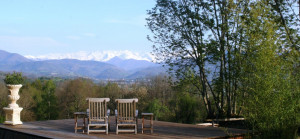
Often when I tell people that we live in the foothills of the Pyrenees, they tend to assume that we are snowbound for much of the winter. Generally they are amazed to discover that, despite the fact that our village is less than 50 kilometres from the nearest ski resort, we actually get snow only a few days a year (if that) and often winter temperatures here are much higher than those in the UK.
Winter nights and early mornings are cold and we wouldn’t be without our wood burner but we are a long way south here so the sun has real warmth in it. Winter afternoons in the sun can often reach 17 or 18 degrees and we regularly sit outside to drink our coffee or enjoy lunch in the sun in February – a phenomenon I don’t ever remember experiencing in England. Cold and snow may be causing havoc in the UK right now but here in the lee of the mountains, we are enjoying the protective Foehn effect which means warm air and sunny days.
What’s more, rainy winter days aren’t miserable and vaguely depressing when you live in the foothills of the mountains because we know that, while it may be raining on us, fresh snow will be falling up in the mountains with all the promise of a fabulous day skiing, sledging or snowshoeing in the sun in the days to follow.
For me this is a perfect winter location; we have sunshine and warmth on a daily basis with chilly nights providing the perfect excuse to snuggle in front of the fire with a hot chocolate. Meanwhile, on the horizon, there is snow sparkling on the mountains with sledging, skiing and fabulous snowy walks whenever we want. The foothills of the Pyrenees truly are a winter wonderland.
Like this:Like Loading...
By nadia, on 5th January 2016 
Whatever your job and your experience, if you are honest, do you really feel qualified to find and buy a French property without some expert (and unbiased) advice? Even if you speak good French, it is probably unlikely that you have a perfect understanding of how the French property market works. There is, of course, plenty of information out there on the internet but there is also plenty of misinformation and it is very difficult to differentiate the two.
Even if you have bought lots of properties in the past, the French property market is different to many property markets. On the internet, there is no Zoopla or equivalent multiple listing site of all of the properties for sale in a particular area in France and, in addition, most houses appear on a large number of different sites, often at different prices with different photos all of which can be very confusing. In addition, of course, these listings are there to sell the property, not to give you the true picture of what the house is really like.
There are certainly plenty of estate agents in France and they will be incredibly helpful and nice when you visit them in their offices but try seeing how many reply and keep you up to date with new properties when you are contacting them from abroad; it can be a very frustrating process according to most of my clients who have tried it before coming to me. Remember an agent is there to sell you a house on their books and they are really not interested which one or whether it truly matches your criteria. Most of these agents work on a commission only basis and so they just want to sell you a house and the more houses they show you, the more likely they think they are to sell you something. What’s more, they only have a limited number of properties to sell and those only in a small area so you will probably need to deal with numerous agents to ensure you get information about every property for sale in the area you are looking.
It is true that coming to France to view lots of properties can be fun to start with but those trips (there are likely to be many) will soon become a huge waste of time because most of those houses you have booked to see, will turn out to be totally unsuitable. If you have plenty of time and not much else to do, this probably doesn’t matter but, if you are short of time, there are probably better ways of spending it.
When time is precious and getting it right is important, why not ask a property finder to do all the research and leg-work for you? A property finder will already have a feel for what is on the market that matches your search criteria and budget. They will deal with all the agents in the area but also the notaires and private sellers and they will also be able to dig out houses that are not on the open market. Once they have done the initial research, they will pre-visit all of the houses which appear (on paper) to match your criteria and it will be their time wasted rather than yours when the majority of these properties do not in fact match up to their promises nor meet your requirements. When your property finder does finally view a house which seems to be a good fit, they will take photos of how it really is and write up a report for you so that gradually you will have a short-list of houses that really do match your criteria.
Hence, when you finally make that trip to view your short-list of box-ticking houses, you know already that it will not be a complete waste of everybody’s time. It will be a well organized and managed few days to maximize your time and show you everything that you have already pre-approved. Moreover, you know that, when you finally meet your property finder, he or she will be completely impartial and able to give advice on all aspects of buying property in France, living in France and will offer an in depth knowledge of their region. Plus, they will be completely on your side before, during and after the sale.
I wouldn’t buy a property abroad without using a property finder; I have too little time and, what I do have, is too precious to waste. If you have similar concerns, why not get in touch, it could well be the best investment you will ever make and certainly the best investment you make this year: nadia@foothillsoffrance.com
Wishing you all very happy and successful property hunting in 2016
Like this:Like Loading...
By nadia, on 24th November 2015 
If you are thinking of buying a house in France, you are most likely caught up in dreams of pretty French houses, delicious food and wine and a slower pace of life. Probably the last thing on your mind is admin, paperwork and bureaucracy. If you are using a property finder, they will deal with most of the irritating and time wasting processes, research and bureaucracy of actually finding and buying the house but there are still some things you need to think about and preferably ahead of time to make your purchase and make your first few weeks in your new house as stress free as possible. In France, the way to beat the bureaucrats is to be prepared.
- Bank account – the first thing to have in place when you decide to buy a house in France is a french bank account. This is not a difficult process and has been greatly simplified for foreigners over the last ten years. There is even a French bank that now offers an English speaking helpline and most now have online facilities where you can easily transfer from your home country to France. Which bank you choose, will depend on your personal situation and the area of France in which you are looking but it is worth setting this up at the same time that you begin your property search.
- Currency transfer – it makes life much easier when you come to make an offer on a property if you have already organised a way of transferring your money from your home country and, ideally if you have already transferred some at an acceptable rate of exchange for you so that your spending power is not overly effected by fluctuations in currency. Make sure you use a reputable exchange company and usually a specialist will get you a better rate than your bank. I work with a currency exchange specialist to get my clients the best possible rate so contact me if you would like a recommendation.
- Visas – if you are not a European resident, you may need a visa and/or a carte de séjour depending on which country you are coming from and whether you are buying a permanent or holiday home. This can take time and lots of paperwork which will need to be translated and often the originals will be required. Never lose your patience with French officials however frustrating the system – you will never come out top of an argument with a French fonctionnaire. Stay patient, smile and ask for their help and expertise to get them on your side; you will get there in the end.
- Official Paperwork – the French love their paperwork; there is lots of it and if it is in duplicate so much the better. Make sure you can lay your hands on all your official documents such as birth, marriage and divorce certificates, driving licence, social security cards, insurance policies, utility bills etc. If you can provide a piece of official looking paper for every demand (preferably with a nice stamp on it), you will thrive in France.
- Insurance – the French also love insurance and you will need insurance for your house, car and health and also for your children if they are going to go to school in France. In France people generally stay with the same insurance company and most will use a local company and deal with them face-to-face – online providers have not really taken off yet in France; here people like to shake the hand of the people they deal with. So take the time to find the right company for your needs. In the past, you had to give three months written notice to cancel a policy and wait for the renewal date but recent changes to the law make it easier to change providers as you no longer need wait for contract renewal date to change over.
- Utilities – once you have a completion date for your French property, it is wise to inform the electricity and water providers that you will be moving in to ensure that you do not get cut off. On the day of completion, you need to read the meters and call the utility companies with the readings and to change the accounts into your name and address where you want your bills to be sent. They might want to see your ‘Compromis de Vente’ contract and you will also need a French bank account in order to get your utilities set up. If you are buying through an agent, they will usually change the utilities over into your name.
- Health cover – you will also need some form of health cover in France but this is very particular depending on which is your home country, whether you are buying a permanent home or a holiday home and whether you are retired or planning to work so you need to look into this depending on your personal circumstances. For anyone from one of the EEA countries and Switzerland buying a holiday home, you can apply for the EHIC card.
All of this may seem like a lot to think about but, if you deal with the necessary paperwork little by little or petit à petit as they say in France, you will find your French house purchase far easier and more enjoyable and your starting life in France a whole nicer experience.
Like this:Like Loading...
|
For further information please contact us:
|
![025[3]](https://foothillsoffrance.com/wp-content/uploads/2016/02/0253-300x182.jpg)



You must be logged in to post a comment.