View from the Foothills of France Some personal views on living, working,
bringing up family and making the dream happen in the most beautiful region of France. View from the Foothills of France also includes some personal and professional thoughts and tips on finding and buying the perfect property in the Ariège and Haute Garonne regions.
|
By nadia, on 23rd March 2022  Balnea in the Pyrenees It’s no wonder that the French love visiting the doctor here in France; French Doctors have at their fingertips the ability to prescribe you ‘the cure’. Now that is what you want from a doctor. Apparently ‘the cure’ can be prescribed for all sorts of illnesses and ailments ranging from arthritis to asthma to diabetes and poor circulation to name just a few.
And it turns out that the cure is just as appealing as it sounds because it predominantly involves a trip to a thermal baths/spa to soak in the water and be given various treatments involving minerals, massages, and thermal mud. These treatments can take anything from a few days to three weeks and, in addition, France having some of the best health care in the world, the majority of the cost of these treatments is covered by the French state with the rest usually being paid for by the patient’s top up health insurance known as a mutuelle.
So, I guess it is not surprising that the market in France for thermal treatments is a large one. In 2021, 326,000 people visited thermal spas for ‘the cure’ and France has more than 770 thermal springs with over 100 stations thermales.
The beneficial effects of thermal cures are well-known since ancient times; the Egyptians, Phoenicians, Hebrews, and Israelites all practiced immersing themselves in cold and hot water and, in Oriental cultures, water therapies were prescribed by religious laws. In Italy, the Etruscans, living in a country rich in natural springs, were one of the first to use water for healing purposes. The ancient Greeks believed in the therapeutic benefits of hot baths and mineral waters and studied their properties and effects on health.
The Romans expanded on the use of mineral and thermal baths as social experiences. They constructed the first large-scale spas with elaborate aqueduct systems carrying mineral waters to private stone tubs, steam rooms and public bathing areas and magnificent edifices (thermae) with a capacity for hundreds or thousands of people.
During the 1800s, bathing became very fashionable and the interest in the health benefits grew; doctors were convinced that for each disease there was an appropriate medicinal spring, which could be discovered through chemical analysis of the waters. Throughout Europe during the Belle Epoch, spas became an integral part of life for the elite. Every spa resort had its own theatre, casino, and promenades besides the bathing buildings. Grand hotels arose with casinos and dancing establishments surrounding the spa resorts.
More recently, health, wellness and spa tourism has become a rapidly growing sector of the tourism industry worldwide.
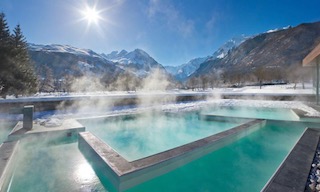
And it turns out that the Pyrenees is the place to come for the most healing and beneficial thermal baths, treatments, and spas. The three regions of the Pyrenees represent 48.6% of the French thermal spa activity and, in terms of the number of springs and the water quality, the hydrothermal richness of the Pyrenees is unrivalled. For example, the waters in our local spa town of Bagnères de Luchon have the highest sulphur content in the Pyrenees. With 118 natural springs, Luchon is one of the oldest and best-known thermal spa towns in France. Plus, in the next valley, there is the much newer Balnéa leisure spa on the banks of Génos-Loudenvielle lake. Here you can bathe in numerous themed, outdoor hot baths while enjoying views of snow-capped mountains and the health benefits of the hot springs which is an incredible experience even when one doesn’t need ‘the cure’.
What does this all have to do with the property market? Well quite a lot in fact, because it explains the year-round popularity of thermal towns in France and hence the high demand for rental properties throughout the year. So, for example, in Bagnères de Luchon, people visiting for ‘the cure’ tend to come in low season which is spring and autumn while the winter season is booked out by skiers and the summer by walkers, cyclists and summer holidaymakers. So, although ‘the cure’ might seem like another generous hand out by the French state, it also has a huge number of knock-on benefits in numerous towns around the country and ultimately ensures both a thriving year-round holiday market and a thriving property and rentals market as well as year-round business for the shops and restaurants.
If you would like help with your French property search or more information, please get in touch: nadia@foothillsoffrance.com
Like this:Like Loading...
By nadia, on 3rd March 2022 
Many of my clients (and many sellers I meet) want to know how the value of French property is calculated. This is not, however, an easy question to answer because there is no one agreed method or set criteria for valuing property here and there are also different criteria used in different regions. The old-fashioned method, still used by far too many agents, is to use the price per square metre calculation but while this may work relatively well in cities, it means nothing here in the countryside where properties are so varied and hence each region and each agent tends to use a mixture of calculations, comparisons and professional or local knowledge to come up with the figure of an asking price.
Some of the most important criteria used here in the foothills region are:
Location – is it a popular or thriving area or an area that is in demand?
Situation – quiet or on a road? Private or overlooked?
View – a property with a mountain view is worth more than one without
Access – to the motorway, to the airport and to the ski resorts
Proximity – to amenities such as shops, cafés/restaurants and schools
Orientation – south or north facing? Sitting in middle or on edge of land?
Number of rooms – particularly bedrooms and bathrooms
Quality of construction – is it a well-built, solid, stone house?
Quality of renovation – has it been renovated professionally or had the dodgy DIY treatment?
Condition – of the roof, woodwork, floors, kitchen, bathrooms etc. Outbuildings – add value if there is possibility of converting them to accommodation but reduce value if they need lots of work and money spending on them
Quantity and quality of land – there is a set price per metre for agricultural land (around 4000 Euros per hectare) which will be added to the property. However, there is then a premium for certain criteria pertaining to the land, for example, if it is flat, if there is woodland, if it is fenced, if there is water and if the land is attached to the property (here land is not necessarily right next to the house)
Demand – if it is the type of property in demand, the price will be more. For example, in this region, a Maison de Maître is generally worth more than a farmhouse of a similar size and condition but an isolated mountain barn in its own land is worth more than a small village house even if the barn needs renovation. And a house in a village that has a bakery or shop, or school will be worth more than a very similar house in a village with no facilities.
In addition, a well presented, maintained and clean house will generally be given a higher valuation than an almost identical house that is dirty and unloved because the agent knows that buyers often cannot see through the mess and so will need to price it lower in order to attract interest.
Hence, there are many criteria that an agent will take into account when assessing and valuing a property but often it will simply come down to experience and knowledge of the market and gut feeling which means that two agents might come up with very different estimations. However, in the current, very dynamic market, agents are pricing to sell, and it is rare to see a house that is wildly over or under priced – unless it is being sold privately which is a whole other matter. Luckily, I see many hundreds of houses each year so I can generally tell as soon as I walk into a house if the price is right.
If you have questions or need help with your French property search, please get in touch: nadia@foothillsoffrance.com
Like this:Like Loading...
By nadia, on 8th February 2022 
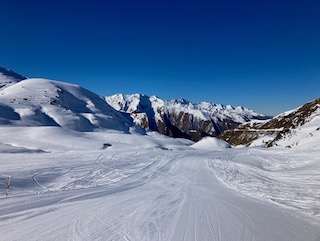
After two years of enforced closure for French ski resorts, this year is proving to be a bumper season. We had early snow in the mountains in November which formed a good, solid base on the slopes and then some heavy snowfalls since with the rest of the time being mainly sunny days and cold nights, the ideal weather for the resorts to attract skiers and to be able to make snow overnight with snow cannons to keep the pistes in top condition.
What I love about living within striking distance of the Pyrenees is that ability to take a day off at very short notice and spend the day skiing when the conditions are perfect, and the slopes are empty. Of course, skiing is always going to be regarded as an elite sport and a luxury by most people but, at our local resort, we can still ski all day for under €25 and, if we take a picnic, that is not the most expensive day out. There are cheaper lift passes for children and retirees and it’s free if you are over 75. In the Alps, the cost of ski passes would be double as would food and drink on the slopes but skiing in our region is not seen as a luxury; it is something most of the locals do in the winter while in summer they will go for a walk or bike ride. Children are taken skiing with school from the age of 4 if the conditions allow and there is also a dedicated ski bus every day in the season from our main town that will take you to the ski station and back for €2. It would cost more than that to get a coffee in many parts of the world.
It is still magic to me that we can leave the house at 8am and be on the slopes by 9am with hardly a soul to be seen and then back home in time for a cup of tea on the terrace in the sun while looking at the snow high on the mountain where we have just been skiing. Life really doesn’t get much better than that.
If you need help in finding your home in France, please get in touch: nadia@foothillsoffrance.com
Like this:Like Loading...
By nadia, on 11th January 2022 
If Covid has taught us anything over the last two years, it is to make the most of the good times. So, if one of your resolutions is to spend more time in France this year, then here are some things you can look forward to:
1. Markets and fresh food culture
Buying most of your food at local markets really does improve health both physical and mental. In this part of France, there is a strong culture of buying local, organic and seasonal produce so that’s a big tick in the better health box. But also, buying from local producers, talking to them face-to-face is the perfect antidote to all those zoom meetings and working from home. You get to interact regularly with local people, chat about the food, put the world to rights and remember the elements of everyday life that really matter.
2. Work-life balance
This is something that has been thrown into strong relief over the last couple of years, but the French already have this much better under control than most other countries. In France, you will find that, while people work hard, they also have clear boundaries and do not let their lives become consumed by their work. The French most definitely work to live and not the other way around.
3. Slower pace of life
While shops closing at lunchtime and on Sundays and having to queue while people write cheques can be frustrating, it does also teach you to slow down and remember that life isn’t a race and there is enjoyment to be found in taking one’s time and doing not very much. So, enjoy those leisurely lunches, the slow shopping at market and rambling Sunday walks and picnics; what’s the rush?
4. Excellent value restaurants
Talking of long lunches, you can still eat out in southwest France for incredible value; a three-course lunch with a glass of wine and a coffee is still available in most places for under €15 per head and you can take your time too; French restaurants serve between 12 and 2pm and only one service per table so you will never feel rushed.
5. Empty roads
Not something I really appreciate enough until I travel abroad, and I am shocked at how busy the roads are and how long it takes to get anywhere. Of course, we have jams around the cities here but, for most of the time, you will be cruising on empty roads and enjoying beautiful, unspoiled views, wide, open spaces and stunning scenery at the same time.
Like this:Like Loading...
|
For further information please contact us:
|


You must be logged in to post a comment.